Part Two
The violence of the girl’s reaction flung Grubhurst away from her. He put up his hands in surrender. “I’m trying to help you.”
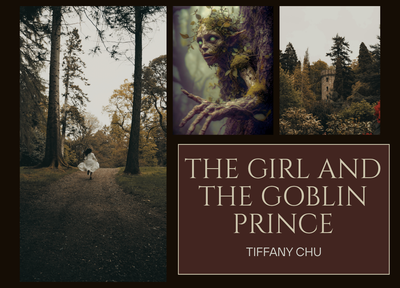
She stared at him. Grubhurst tried to imagine how he appeared to a human who had never encountered a goblin before. Moss-green skin—not smooth, but like lichen growing over logs in an ancient forest that hadn’t been touched by any living soul for a thousand years. The texture of it caught light unevenly, rough as tree bark in some places, smooth as river stone in others. Round eyes, seemingly too large for his face. If he smiled, the girl would see pointed sharp teeth—not just two or four canines like humans, but each and every one. His body was hunched from walking the tunnels, his ears long and pointed. When he moved, his joints made small clicking sounds, like twigs settling.
The girl gasped. “What are you?”
“A goblin.”
“Goblins don’t exist.”
Grubhurst gestured to his face and body. The girl’s burst of hysterical laughter surprised a laugh out of him. The sound echoed strangely in the close space between trees—not quite human, with an undertone like wind through hollow logs. For a moment, they could do nothing else in the face of the absurdity of the situation.
The snap of a branch returned Grubhurst’s senses to him, and he gestured for the girl to follow him. “It’s not safe. Come quickly. Get to higher ground.”
Together, they dipped beneath the arch of many low-hanging branches, tracing familiar paths Grubhurst knew well. The forest floor gave beneath their feet—soft loam and decomposing leaves that released the smell of rot and growth with each step. With every crackle of the dead leaves beneath the girl’s feet, and rustle of bushes, he cursed inwardly at the noisiness of people. Like a herd of wild oxen, he thought to himself. He tried to signal to her to quiet her movements, but the need for speed warred with the one for stealth, and he hoped the fog would be enough to hide them from immediate sight at least.
It was not for nothing Grubhurst had earned the nickname of “Most Likely to have been a Hobbit in a Former Life” amongst his siblings, however. He knew secret ways throughout the island his siblings didn’t—not even Prismilla. His odd desire for solitude (“Quite un-goblin-like behavior,” tsked Tribthurst) propelled him to search for hiding places. He led the thundering buffalo of a girl to one such place: a boulder beside a river, hollowed out just enough for a smallish goblin secrete oneself in, a tree growing atop it with long roots spreading bizarrely over it like a curtain until they reconnected with the earth below. The roots smelled of damp and mineral, and water dripped from them in a steady rhythm. Some were as thick as Grubhurst’s arm, others thin as ivy.
“There?” the girl hissed, looking doubtfully at the small space.
And no wonder. It must look like a perfect place for Grubhurst to have lured her to in order to break her bones and munch on her young, supple meat. He raised his eyes to the sky in frustration. “Okay. Okay. I get it. I’m a goblin. You’re a human. Goblins eat humans. Pointy teeth don’t do me any favors. But right now, my sixteen brothers and sisters are coming down the mountain looking for people from that ship, they’re very hungry, and I’m your only chance for survival. Squeeze in.”
The girl’s eyes widened, and she raised no further objections.
It was a wonder the two of them fit into the hollow, though it was undoubtedly tight. Though small compared to his siblings, Grubhurst still had the build of a goblin—you know, stocky, wide arms and legs—imagine a being with all muscle and little give. The space smelled of wet stone and the particular mustiness of places where sunlight never reached. There was really not much to hold in to get into snug places. And the girl was no small thing either, Grubhurst thought ruefully. It would have been easier if it had been a little human, but of course it had to be one of those fully fledged ones with their limbs all grown out already. What a strange day he was having.
After settling into very uncomfortable positions, with much grumbling from aforementioned girl, Grubhurst shushed her. Their breathing filled the small space, humid and too close. He turned his ears this way and that, trying to catch a sound of padded footsteps on the forest floor. He hoped his siblings’ excitement about new food might cause them to dispense with some of their caution moving through the woods, but he couldn’t depend on that. Some of the little ones could traverse their hidden paths quite silently indeed. His brothers and sisters would be moving to the beach, though, while he and the girl had ran the other way. If they hadn’t been caught by now, perhaps they were safe for a time.
Sighing, Grubhurst released some of the tension in his body before he turned to the girl at last and looked at her properly.
She was staring back at him intently, as though studying him. The air of disbelief had somewhat dissipated, though she still looked at him like he had popped out of her storybook and started talking without permission.
“So…” he started, just as she said, “What do you mean you’re a goblin?”
He stared.
“I mean,” she began again, “how?”
“I don’t know where you’re from, but goblins have always lived on this island. I’ve been a prince here for more than a hundred years. Unless…those fairy tales about magical portals…” Grubhurst shook his head. He leaned back and fought the desire to laugh again at her stunned expression. “But why are you here? No ships have come for a century, no people. It’s just been us. Why are you here?”

At the goblin’s question, Aletta’s head began throbbing. Her temples pulsed with a pain that sat behind her eyes like pressure before a storm. It often did when something reminded her of her mother. Her hands twitched; they itched for some colorful square paper to fold into lotuses, cranes, or butterflies. No chance of finding paper here.
She could tell him that she and her family had been journeying from the island of Formosa back to her grandparents’ home in Amsterdam because of the violent riots. They had only been there to trade, her father said; it was time, now that the Chinese military leader, Koxinga, had determined to take Formosa for his own. That she had not wished to leave Formosa, because she still nursed lingering hope for her mother’s return. That she’d been born and raised in Formosa, that that was her home, not Amsterdam. She could still smell the market stalls—star anise and ginger, the sweetness of longan, the mineral scent of fresh fish on ice. That her grandfather had also demanded their homecoming in a sternly written letter to her father. That there had been talks of the need to “get Aletta settled.” That everything had been fixed without so much as a by-your-leave.
And as she thought these thoughts that had been bubbling up for so many months of preparation before, then many more months on the sea, she felt the tears burning her eyes, and realized she had been saying the words out loud. Her voice came out hoarse, roughened by salt water and crying.
She looked up at the goblin, a curious expression on its strange face—a mixture of pity and…could it be…understanding?
“Where did your mother go?”
And Aletta didn’t know why—except perhaps that there was still a part of her straddling the threshold between belief and disbelief that the situation she now found herself in was quite, quite real—but she told the goblin about her mother disappearing into the mist when she was a mere babe, about her father never really looking at Aletta, but above and around her, about her aunts’ constant fussing over her safety but mostly over her turning out a proper lady and “not a wild, savage thing” like her mother had been,” about the children who’d laughed at her almond-shaped eyes and “stubby nose” and called her an alien, and about her family never, absolutely never, talking about Aletta’s mother.
The words cascaded from her lips, almost as though she could not stop their flow. On they went, like the current thundering outside the hollow. The sound of rushing water accompanied her confession, a constant backdrop to grief.
When at last she had exhausted herself with speech and her breath escaped her in quiet but heaving pants, the goblin said only, “My mother and father disappeared into the mist, too.”
Aletta hiccuped. “They did?”
It nodded. “I don’t know where they went either.” After a pause, it said, “I’m called Grubhurst.”
“Aletta.”
Thus was something of tenuous friendship wrought between the two.
“What about your hungry brothers and sisters, then?” Aletta asked, releasing a shaky laugh as she adjusted her position on the rather unforgiving stone ground. The rock beneath her was cold enough to leach warmth through her wet clothes, and she shivered.
“I’ve been listening for them. I don’t know if they saw you come on the island; they were still bickering when I left them. Hopefully their attention was elsewhere.” Grubhurst leaned out, against the roots enclosing them, and she mirrored his movement, drawing closer to him.
Aletta had the sudden and unwelcome thought that should one of his siblings come upon them, they would be utterly doomed. Or rather, she would be. Then, she wondered what Grubhurst’s relationship with his siblings was. Why did he not savor her flesh, after all, when they did? The notion arrested her motion. She slowly backed away again.
Grubhurst did not seem to notice at first, but sat back with a small grunt. “It’s not that I’m a vegetarian,” he said with an odd twist of his mouth. “But, we haven’t seen humans for a hundred years. My brothers and sisters may not find that something worth thinking about before trying to have a nice meal, but I do.”
“If there haven’t been any humans, what have you been doing all this time?”
“Bickering over the sheep and other animals, trying not to eat them faster than they can reproduce, which they did to the sheep. You know, goblin stuff.”
The out-of-place response dragged a guffaw from Aletta’s core that doubled her over. Her laughter rang too loud in the enclosed space, and she clapped a hand over her mouth. Oh, she could have been proper friends with this goblin under less dire circumstances. The situation was far too absurd. No one would ever believe her. Well, perhaps her mother would have—that mysterious woman who ran into the mountains with the mist. The thought sobered Aletta like water from a frigid river.
A wry smile painted itself over Grubhurst’s face. “Can’t be a coincidence. Your mother and my parents vanishing into thin air, your ship passing my island and getting through whatever barrier kept it hidden all this time.” He looked at her with an expression of—hope?
She swallowed. A dangerous thought began to take root in her mind—the kind that was sure to fester if left in the damp recesses of her father’s dim library, but here where magic and goblins exist, might just take wing. “What if,” she said, “my mother found a portal to your island somehow?” The other kids called her a witch, after all. What if she really was?
“And what if my parents noticed and tried to keep her out? There’s an old lighthouse on the island. No one knows where it came from, but goblins don’t build.”
“Maybe she tried to come through there. And then their magic clashed.”
“They all got transported somewhere else.”
“Yes, but where?”
“And how do we get them back?”
The two faltered into silence. Aletta looked around the small cave, and noticed with some surprise that the sun was making its descent into late afternoon. The light filtering through the root curtain had turned golden, painting everything in warm amber. She wondered how big the island was, how long Grubhurst’s siblings would take to scour the land, then jumped up with a tiny scream, forgetting in her excitement the cramped space she was in, and colliding her head with rock. Pain bloomed across her skull, bright and immediate. With watering eyes and ringing ears, she crouched back down. She ignored Grubhurst’s inquiries after her well-being, saying instead in a sort of choked voice, “Do goblins swim?”
No spam, no sharing to third party. Only you and me.
Member discussion