Shine for the Fat Lady
Hello, I’m Tiffany, your resident town hermit. Welcome to my fellowship—a haven where you’re free to talk about taboo subjects you can’t anywhere else. Learn more about The Untangling here, or subscribe to never miss a post.
As an indie author, I don't have a publishing team behind me to help market my books, so I rely heavily on word of mouth and reviews to reach new readers. If you've read one or more of my books, please take a moment to leave a review here and/or here. It truly makes a huge difference. Thank you so much!
- Don't forget to enter the international giveaway for the special edition copy of A Girl Made of Time, just by signing up for the Kickstarter page and emailing me your screenshot.
- Free ebooks! Get your free ebooks here! Horror, sci-fi, fantasy, and YA. Check out this wide selection.
A short playlist to accompany your reading, if you'd like
This review-essay was first published on Ford Knows Books in March 2026. Slight spoilers ahead.
Below the paywall, you'll find life updates and a glimpse into my reading journal, and a personal recommended reading list based on this essay, plus a first look at The Constellation of Forgotten Things cover draft!
Here's a printable PDF of the essay for those who prefer reading offline.
Dear Inklings,
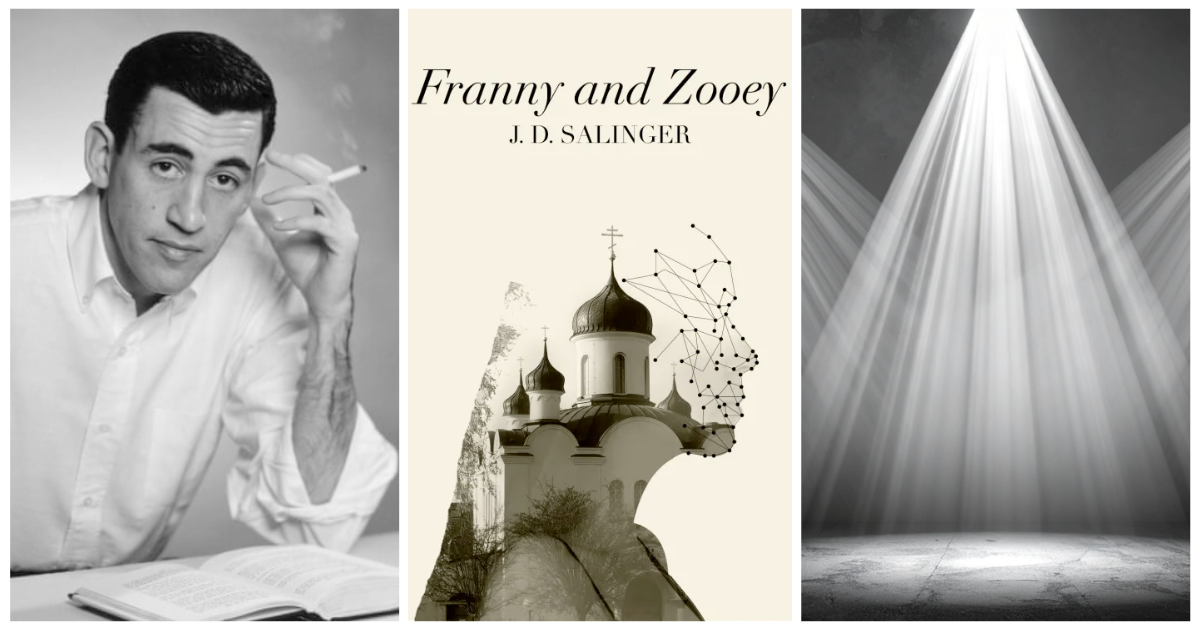
You’ve heard of Catcher in the Rye and Holden Caulfield, but have you heard of the genius Glass children?
Franny and Zooey Glass are the two youngest, out of seven. They are smart—brilliant, in fact. The 150-page book comprises of one short story (Franny) and a novella (Zooey), originally published in 1955 and 1957, respectively.
Franny opens with Franny on a date with her boyfriend (also smart, but in a shallow way, as we quickly find out). Franny is in a Dark Night of the Soul; she is disillusioned by her experiences at college and the people around her. It’s reminiscent of Holden’s constant refrain of, “Everyone is a phony” (a recurring theme in Salinger’s works). Over the course of their dinner conversation, Franny grows increasingly distraught until she suffers a nervous breakdown.
When we meet Zooey in Zooey, Franny has been staying at home recovering from her breakdown. Following prodding from their mother, Zooey engages Franny in a long, philosophical discussion about humanity, intellectualism, and theology.
Franny and Zooey came into my life at the cusp between childhood and adulthood. I was on track to pursue a career as a classical concert pianist after spending my entire life training for it. This was a path chosen for me by my mother from the time I was five years old. I walked it unquestioningly to please her and my piano teacher(s) who took pride in me. I did it for the acclaim of being known as a gifted performer. It was my identity. Beneath simmered the insidious thought, “I don’t know how to do anything except this; if I don’t continue, I have no future.”
Of course, it was dramatic adolescent catastrophic thinking, but at the time, it certainly felt like life-or-death.
By the time I began reading Franny and Zooey for my high school senior English class, I was on the verge of a nervous breakdown not unsimilar to Franny’s—questioning my own motives for pursuing music, wondering what true art meant, whether I even loved music or just the pride of being good at it. Ah, the war between external validation versus internal was fierce and bloody. Beyond that, there was another war getting entangled—one between superficiality and authenticity.
I’m just sick of ego, ego, ego. My own and everyone else’s. I’m sick of everybody that wants to get somewhere, do something distinguished and all, be somebody interesting. It’s disgusting…
–Franny Glass
You see, Franny and Zooey (and all the Glass children) strive for authenticity. They despise those who chase after accolades for the sake of the accolades. They love art for its own sake. Franny and Zooey know they are different—clever. Their existential dissatisfaction bubbles over from their awareness of these differences between themselves and others. They are intense. They are passionate. They want to, as Thoreau puts it, to “live deep and suck all the marrow out of life,” and are disillusioned that those outside of themselves are content to chase after superficial accomplishments like degrees and fame and commercial success. And yet, Franny realises that she herself can’t quite extricate herself from the need for validation. The cognitive dissonance leads to her breakdown.
In Zooey, Salinger takes us deeper into this theme, as we’re given more background on the Glass family, but especially Seymour—the oldest Glass child, who killed himself seven years prior to this story’s events. Given that detail, it becomes all too clear that the stakes are immensely high, as Zooey is tasked by their mother to bring Franny back from the edge.
Zooey himself struggles with the same problem in a different way. He recognises the hollowness in many of his peers and artists, and it leads him to a distinct apathy. Where Franny is breaking down from caring too much, Zooey suffers from caring too little. Older brother Buddy Glass (widely regarded as Salinger’s alter-ego), rebukes Zooey in a letter for his impossible expectations for not only himself, but everyone else:
You may have seen “inspired” productions, “competent” productions, but never anything beautiful. Never one where Chekhov’s talent is matched, nuance for nuance, idiosyncrasy for idiosyncrasy, by every soul onstage. … I can so clearly see you demanding something from the performing arts that just isn’t residual there, ... Enough. Act, Zachary Martin Glass, when and where you want to, since you feel you must, but do it with all your might.
For the love of art
Though I’ve read Franny and Zooey several times over the years, it’s eerily timely now, as I, like many others, have been mesmerised by Alysa Liu’s joyful performances on the ice. She embodied passion, and she did it for no audience, but purely for the joy of her art. Because of that, she triumphed in spite of previous setbacks. More than that, she shone.
Very few of us will make it to a world stage. Most of us won’t have an audience size that will make headlines. That’s not the point, though, according to Franny and Zooey and Alysa Liu herself.
The point is the love of art.
An artist’s only concern is to shoot for some kind of perfection, and on his own terms, not anyone else’s. You have no right to think about those things, I swear to you.
–Zooey Glass
It’s ultimately about love.
And humanity.
In the pseudo-introduction, the narrator, Buddy Glass, states,
I say that my current offering isn’t a mystical story, or a religiously mystifying story, at all. I say it’s a compound, or multiple, love story, pure and complicated.
I briefly mentioned the Glass children’s mother earlier, but let's hone in on her for now. Bessie is the antithesis of her children. She’s not brilliant or particularly perceptive. She is, in a word, mediocre. Mrs. Glass is your average mum who just wants to feed her ill youngest daughter a bowl of chicken soup. She’s also a woman who has lost two children—Seymour to suicide, and Walt to war—and thus possesses the sort of wisdom that only comes from grief.
In a long conversation between Bessie and Zooey, she entreats him to talk to Franny, who has been convalescing in the living room since her breakdown at school. Amidst the meandering, philosophical dialogue (and oh, is this book heavy on dialogue), underlies a theme of love. As I said, Franny and Zooey are part of a large family. Like any family, it has its problems. But despite differences in both personality and intelligence, they do love each other. The family is central—broken and dysfunctional as it is.
Where her children are the brains, Bessie is the heart; she reminds us of the essential:
“I don’t know what good it is to know so much and be smart as whips and all if it doesn’t make you happy,” she says. “At least, you all used to be so sweet and loving to each other it was a joy to see.”
Despite Zooey’s blatant disrespect for Mrs. Glass (constantly calling her stupid and fat, among other things; I’ll come back to this), her message hits home at some point, because he later conveys it to Franny himself. In the end, what really matters when “The goddam sands run out on you every time you turn around…You’re lucky if you get time to sneeze in this goddam phenomenal world”?
Some of us learn this early, and we’re lucky. Some of us only learn it on our deathbeds and realise we’ve wasted a lifetime pursuing the wrong things.
Because what good is it to be the best at something if we can’t find joy in it? What good is it if our relationships fracture and we wind up lonelier than before? Time is not guaranteed, and the human lifespan is "absurdly, insultingly brief," (Oliver Burkeman, Four Thousand Weeks.)
(Good lord, I’m falling prey to Salinger’s excessive use of italics; save me.)
I learned from Franny and Zooey to find the sacred in the mundane. In this book, that comes up again and again in the form of Bessie’s chicken soup, which she continuously offers to Franny and is rebuffed. I was reminded of the form of love East Asians are particularly familiar with: the offering of food, in which parents don’t say, “I love you,” but instead, “Have you eaten?” Where love shows up in immigrant parents' late nights learning a foreign language and being ridiculed during the day in an unwelcoming country, so their children don't have to grow up knowing poverty and war like they did.
How in hell are you going to recognize a legitimate holy man when you see one if you don’t even know a cup of consecrated chicken soup when it’s right in front of your nose?
Beyond that, there is love for humanity—even toward those who exist on different levels and cannot see what we see.
When Zooey calls Bessie fat and stupid, there’s a specificity to these terms. To Franny and Zooey, to be stupid is the worst insult. To be fat—well, it is a way the Glass children divide up the world.
We're freaks, that's all ... We’re the tattooed lady, and we’re never going to have a minute’s peace, the rest of our lives, until everybody else is tattooed, too.
–Zooey
Tattooed Ladies are enlightened. Fat Ladies are the stupid masses.
And yet. And yet. Zooey imparts to Franny a piece of wisdom from Seymour: “to shine [my shoes] for the Fat Lady.” Even when they can’t see them anyway.
But I’ll tell you a terrible secret—Are you listening to me? There isn’t anyone out there who isn’t Seymour’s Fat Lady. … And don’t you know—listen to me, now—don’t you know who that Fat Lady really is?...Ah, buddy. Ah, buddy. It’s Christ Himself. Christ Himself, buddy.
Now I’ve given away the punchline (please forgive me), but this is where Franny’s turn became mine:
Create, even when no one sees it.
Create, even when no one appreciates it.
Create, even when no one understands it.
Create for yourself.
Create as though your audience is the most perfect, divine being you can think of.
Piano was not for me. I had known it for a long time, but it took this book to help give me the courage to change my lifelong path, and another year after reading it to change it entirely. I made the decision after one year as a piano major at UCLA, to my mother and childhood piano teacher’s shock and dismay (who was already disappointed I hadn’t chosen to go to USC, "the Juilliard of the west coast")—and switched to a psychology major.
I knew absolutely nothing.
It felt like being thrown into an alien world, learning biology and statistics, thinking in terms of data instead of music scales.
And yet, the world did not end. I found my footing and graduated half a year early, in spite of switching majors. A bachelor's degree in psychology gets me nothing in the world, but I absolutely loved studying it. I was happy. My mom did not disown me, but rather came to embrace my choice. My piano teacher is still in my life. And, I still play, but only for myself.
I learned something about my art, whether that be piano playing or writing or making soup for my children: that it doesn’t matter who sees it or who appreciates it. What matters is that I’m doing it with all my might.
At the time when I read Franny and Zooey, I felt utterly alone. I was deep in my own Dark Night of the Soul, and no one could see or understand. I didn’t belong anywhere. My strange perspective isolated me from others on a soul level, and I could never reconcile with it. The feeling made me bitter and hopeless about people, about life. When I read this book, I felt seen.
This is a book for the outliers. It’s for anyone who wonders what the point of everything is. It’s for those who see the world differently and wish they could be brave enough to fight against it.
This book is for the “freaks.”
With Love,


Thank you, Alan, for donating to my last essay about Taiwan! Alan wrote:
"I love reading this book "review" while I am visiting Taiwan! It is crazy to see some of the thoughts I have processed come alive in your writing!"
My upcoming short story collection was written for the freaks, for those who search for belonging. Sign up here to be notified when it launches.
About Me: Tiffany Chu is a Taiwanese American writer based in San Diego. Her essays and short stories have been published by San Diego Writers, Inc., Chicago Story Press, and Renewal Missions. She writes about evergreen themes of grief, belonging, and what it means to be human. She's been writing this publication, The Untangling, since 2023. Order my books here or here.
Subscribe to continue reading