A Beast Slinks Towards Beijing
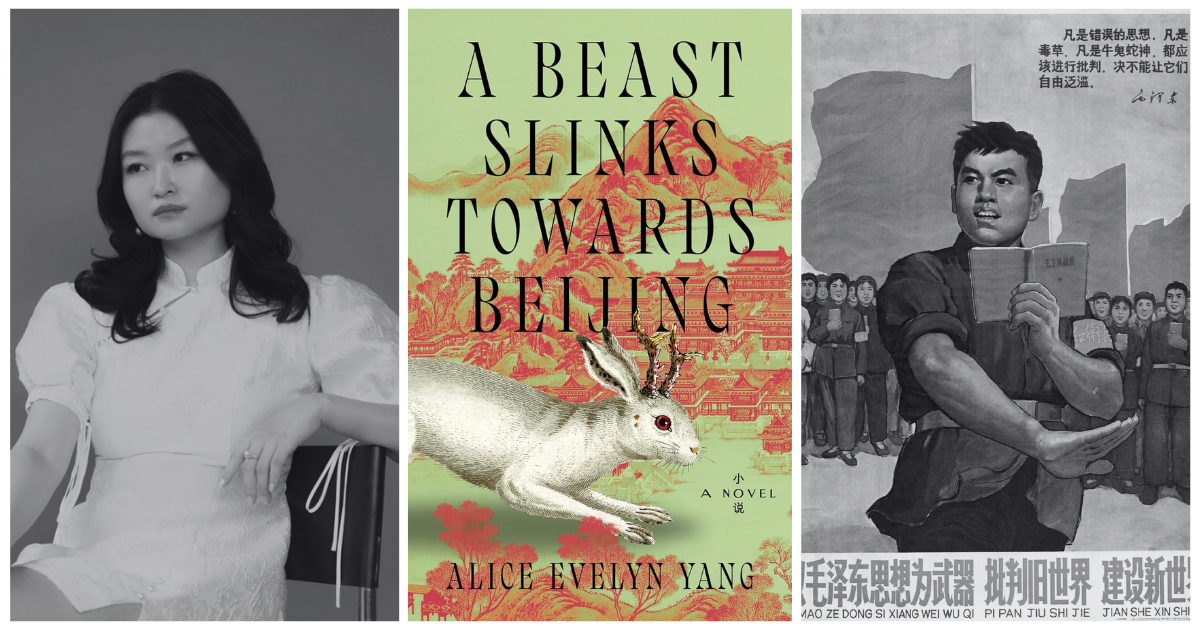
Genre: Literary Historical Magical Realism
Release Date: 27 January 2026
Publisher: William Morrow
Format: Hardcover
Source: Bookshop.org
There was a saying among the Aunties: One’s family is not a brief tempest but a lifetime of mist. A constant fog, whose wet texture of hurt would always be there.
During a Chinese language class in college, the professor had us watch Zhang Yimou’s To Live: a movie that followed a peasant man and his family from the beginning of the Great Leap Forward through to the Cultural Revolution in China. The story is a sad one, as you might imagine. As the movie progressed, I heard several classmates sobbing at various points.
When I mentioned it to my mom later, she admitted she dislikes Zhang Yimou’s movies because they’re too depressing.
“Why are they like that?”
Without missing a beat, she replied, “Chinese people have a lot of (collective) sorrow.”
Children of Asian immigrants sometimes joke that our parents never tell us anything important, but never is this more apparent than when it comes to family history. As though by collective agreement, the destruction of previous generations is rarely, if ever, talked about—either because it’s too difficult to ponder over, or for the reasoning that looking forward is best for everyone.
The unintended side effect is a sense of rootlessness amongst children of immigrants.
Such a feeling permeates our upbringing. It’s the unspoken ingredient of the Asian diaspora, and yet it lingers in between the “Have you eaten?”, “You’ve gotten fat,” “You’ve gotten skinny,” “Which school did you graduate from?” “When are you getting married?” queries like a second skin everybody can see but nobody ever talks about. They can’t say “I love you”; they say it with food and hope the meaning is clear enough.
“It’s too sad,” the elders might say. “Who wants to think about the sad past (we left all that behind when we left our homelands)?”
Whether through silence or lies, the prevailing theme of first-generation immigrant children is that we often know next to nothing of our families. I have put things together piece by piece throughout my life—sometimes with information given to me directly, sometimes accidentally, and other times through extended family members who each have their own perspectives.
In A Beast Slinks Towards Beijing, Qianze wrestles with resentment toward the father who abandoned her on her fourteenth birthday then reappears eleven years later, and the compulsion to be a “Good Chinese Daughter.” Her Ba’s leaving also teaches Qianze to hide from not only her parents but others around her. In their Chinese family, keeping secrets from each other was a form of love and protection.
She loved him too much to chase him away with the terrifying truth. She didn’t know if this was the way other people loved, if it was the right way to love, if her ability to love had been ruined before she met him.
How familiar this feels to me.
While I was too young to remember many details the first time my dad was diagnosed with leukemia, I, like Qianze, was fourteen when the cancer returned. My parents nobly kept details from us. There was instead the unspoken rule that I must carry on just as they were doing—that is, without speaking of the troubles, quietly not making trouble. Emotions weren’t talked about. As they hid their sorrows from me, so I tried to hide mine from them. But, being in an awkward transitional period of adolescence and entering high school caused the churning to spill out. Suddenly, I was no longer the Good Daughter. I had my own beast.
A Beast Slinks Towards Beijing is a study in intergenerational family trauma—specifically the kind that is passed down in silence.
Qianze knows almost nothing about her family history, but it has affected and influenced the trajectory of her life nonetheless—her parents’ unwillingness to share their experiences with her out of a noble sense of protection fails her. She is isolated and broken, stuck in a job she chose as a result of the circumstances that led her grandparents, then her parents, to make their choices. Yet because she’s ignorant of those circumstances, she also can’t see how each step from previous generations has followed her to her present situation; it becomes the nightmare haunting her that she doesn’t understand.
The narrative flashes back and forth between three generations: Qianze, her father (Weihong), and Weihong’s mother (Ming).
Beasts stalk all three members of this family. The beasts are around them, within them, and follow the children’s children until someone recognises it and tries to break the cycle. It shows up as a violent jackalope in Qianze’s nightmares and fox spirits following her on her commute—until she eventually questions her sanity. It’s a stark illustration of how a child who’s been told nothing can only experience inherited pain as something wrong with her.
This half-life she was living was because of her father leaving, her father’s hurt. But her father’s hurt had come from his father’s hurt, and now she could see what might become of her life, how it might become a reflection of his. He had left to protect her, but he had made her into an angry person, unable to move on from his abandonment … Would it not be better to stay? To try?
I read the beast as a manifestation of intergenerational trauma passed down through DNA, which is why it can stalk someone who was never told what it is.
A Beast Slinks Towards Beijing blends elements of mythology and magical realism with history, because some experiences are still too painful to speak aloud in anything other than metaphor. In this book, Yang uses the beast to say it for those who are unable.
The book is horrifying and visceral. It goes into great detail about the atrocities committed between humans during the time periods in which it was set. One could mistake it as written for shock value, but befitting the theme, it’s necessary to know the brutal details of that time period to understand.
One particular segment involves Ming, Qianze’s grandmother, captured by the Japanese to serve as a comfort woman and being repeatedly raped by one diabolical man. Ultimately, this shapes all the consequent events of the book; her trauma is the beast that is carried forward.
Another shows Weihong, Qianze’s father, joining the Red Guard and committing countless atrocities. He murders several people in horrendous ways so the authorities won’t suspect him or his family of subversion. The terrifying part is when Weihong begins to wonder whether he is starting to enjoy the brutality.
Yang does not shy away from people’s capacity for evil. Yet the question she left me with is, “If caught in such horrendous circumstances, how would I choose?” Her characters make decisions to survive, to protect loved ones, and that is what drew my mind back to my parents’ choices to keep silent. For theirs and previous generations, emotions could not be spoken of. To survive was more than good enough during a period even that wasn’t guaranteed. And I can’t fault them for not giving me what they didn’t know or have to give. As one of my aunts once told me, “Back then, if we all made it to adulthood, that was a big accomplishment. No one had time to consider things like mental health.”
Ma would never be a paragon of motherhood, but she had done her best. A faltering, imperfect best, but her best nonetheless. Qianze had been bitter that Ma wasn’t the kind of devoted mother that Qianze wanted her to be. Adulthood had showed Qianze that Ma was only human.
At other times, the writing is so atmospheric and lyrical that reading it felt like being in someone’s dream. Indeed, since dreams feature so heavily in the novel, this writing style worked particularly well.
This did not seem like a debut novel. It reminded me of The Covenant of Water and Pachinko, both sprawling family epics that span multiple generations and weave those narratives together seamlessly. Where those two books remain in the realistic historical fiction genre, however, Yang blends in magical realism to highlight her themes.
Where the book fell short for me was at the very end, with a resolution that came about too easily after all the intense horrors before. Qianze goes on a long walk after her Ba accidentally blurts out his entire life story. She thinks about everything she now knows, and suddenly decides to relinquish bitterness and resentment. Though the ending paragraph suggests there is more repair to be done, the shift seemed sudden after Qianze spent the entire book in misery, lies, and anger. It wasn’t realistic that she could make that shift so quickly.
A family is a lifetime of mist, indeed. It’s not so easily swept away. Some wounds may never heal. Yang doesn’t pretend there will be automatic healing, even with acknowledgment, rushed and unearned as this part was. She instead suggests a tentative and gentle truce borne of understanding and knowledge.
There were things to come. … There were spider-lily seeds and joss sticks to buy. There was ghost money to burn. A ghost apology. But this was for later. For now, it was September. They were eating hand-pulled noodles.
I’ve begun asking my parents more about their lives and my grandparents’ lives in recent years. Maybe the mist that pervades our family will dissipate a little. We, too, eat meals together—and hope it’s enough to convey, “I love you.”
About Me: Tiffany Chu is a Taiwanese American writer based in San Diego. Her essays and short stories have been published by Open Secrets Magazine, A Year in Ink, and Chicago Story Press. She writes about evergreen themes of grief, belonging, and what it means to be human. She's been writing this publication, The Untangling, since 2023. Order her books here.
No spam, no sharing to third party. Only you and me.

Member discussion