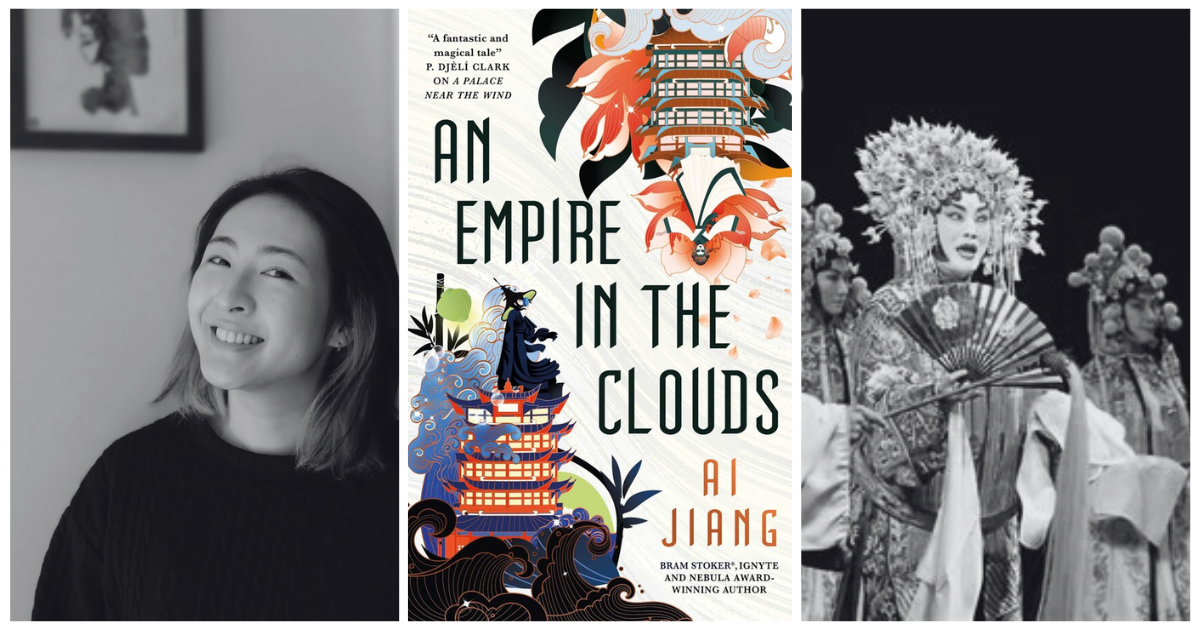
An Empire in the Clouds by Ai Jiang
Genre: Sci-fi Fantasy
Release Date: 8 September 2026
Publisher: Titan Books
Format: Hardcover
Source: ARC received from author
On Piāo, the floating empire of lotuses, Xīlián discovers the royal advisors’ ploy to overthrow her brother, Yún, the emperor, in the same way they had murdered their parents, by creating a deadly flood that will make Yún’s death seem as though an accident. She flees to the drowning continent of Opera, a place of high tech and near environmental collapse where companies vie to sell a chance at immortality. There Xīlián seeks out her exiled brother Làng to help in her efforts to disrupt the advisors’ plans and remove them from court.
Also residing on Opera is the outcast, No Face. Abandoned by the empire of Piāo, they plot to destroy those who tore their family apart. When Xīlián is caught and imprisoned and No Face discovers the shocking truth about their past, the two must work together to stop the advisors and unify their two lands or lose everyone they love to flood and revolution.
How I heard about it
I read every book Ai Jiang writes. When I heard this one was inspired by Chinese opera and also the legend of Mazu, with which I have a certain soft spot, I knew I had to read it.
What I liked
Something you'll never say about Ai Jiang is that she lacks imagination. It is so vivid, her worldbuilding so vast—when I read Ai Jiang, I know I'm getting a rich world with concepts and ideas I've never read anywhere else. In An Empire in the Clouds, the primary conflict is between two countries: Piāo and Opera. Masks are used both as ways to deflect, deceive, and hide, as well as act as a technological adaptation to a world ruined by pollution and ecological disaster. We have giant koi used as transport, floating lotuses, beings bio-engineered to consume smog or eat plastic, among other wildly imaginative elements. Residents of Opera are called Performers and all are non-binary with they/them pronouns. There's subtle commentary on technology—how it can both help and harm.
I enjoy the slower, introspective pace. Ai Jiang writes beautifully; I copied several quotes down as I read. The two main characters muse about masks and how they function, how they offer a place to hide, and what it means to be yourself without being beholden to what others expect. The dedication reflects this beautifully:
For all those wearing a thousand faces and more
For all those wearing a single face without choice.
It starts with the individual but ends with the community.
It takes first an understand of the past to change the future.
It begins with ourselves before it spreads, like a drowning sea.
No Face was my favourite character, as anyone would probably expect. I have a thing for tortured outcasts who nevertheless find a family outside the one that rejected them. No Face was one of the more complex characters who made questionable choices that I, as a reader, could still understand.
Underlying everything, of course, is opera—or rather, storytelling through opera. In Piāo, opera is used to distort truth and oppress people, keep them from rebelling against those in power. In Opera, it's used to express truth.
The theme of storytelling as a way of shaping the world resonated with me—as a fellow storyteller, but also as a reader and observer who has noted the dangerous spinning of stories to mold minds. How easy it can be to twist the truth, and how much more essential knowing our own history is—the ugly, the good, the parts we tend to brush over—for standing firm against corruption.
Because both Xīlián and No Face spend a lot of time mulling over the past—both personal and collective—and ultimately it is knowledge of the past that allows them to face the present and fight for a better future.
What I didn't like
One of the main narrators, Xīlián, is supposed to be nearly a hundred years old, but comes off as a teenager. I understand that she's lived a sheltered life, but even so, I found it hard to believe she could have lived so long without questioning anything about her life. The naivete was rather unbelievable.
This is a nitpicky point, since Ai explains her reasoning for this in the acknowledgements, but I really didn't like the use of "x" for Opera's dialect. It threw me off all through the book.
Overall
For a first full-length novel, I'm not disappointed. Ai Jiang continues to deliver books I love to read and spark my own imagination. She's a pretty fast writer, but I'm always and already impatient for her next book.
Who would like this: readers who like their fantasy/sci-fi slower paced and more reflective; though there is action, it takes a while to ramp up to it, those who like books that challenge them a little in thinking and immersing into a different culture, those who like sprawling, imaginative worlds
No spam, no sharing to third party. Only you and me.
Member discussion