I Wanted to Hate R.F. Kuang’s Taipei Story
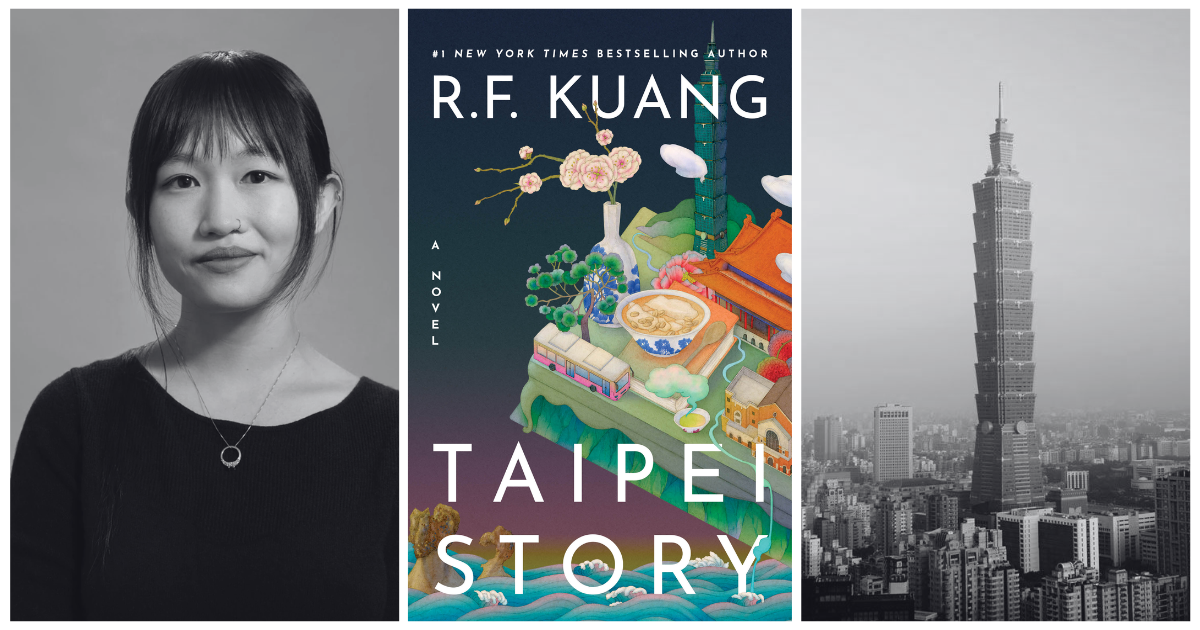
I’ll be honest: I had dirt-low expectations for R.F. Kuang’s Taipei Story, and indeed, railed against it for a long time even before it was published. For a Chinese person to be writing about Taiwan when there are so many Taiwanese authors worthier of notice seemed, to me, a travesty. Colonisers should not be allowed to write and profit off writing about the countries they have colonised. This was a much more egregious offense to me than, say, the controversy for which Kuang was getting cancelled.
Still, when the book became available on Libby, I picked it up anyway, even with my reserves. At best, I thought, it would be an easy read, and I could spend a couple hours reminiscing about my homeland through Kuang’s descriptions.
While I hold to my opinion that descendants of occupiers shouldn’t write about the countries they’ve oppressed, Taipei Story ended up surprising me with its nuanced approach to themes of colonisation, language, and intergenerational conflict and trauma.
Though it’s not a perfect or great book by any means, I’m glad I read it, though I wouldn’t reread it. There are still plenty of other excellent books by actual Taiwanese authors I prefer to pay attention to.
Taipei Story centers around Lily, a Chinese American college student studying abroad in Taipei for an intensive language summer program. Kuang actually addresses the question of young Chinese people choosing to reconnect to their roots in Taiwan instead of China—because visas to China are more difficult to obtain (you don’t need a visa to visit Taiwan), because Taiwan is more accessible, because Taiwan actually has many of the historical artifacts from China,1 etc.
I didn’t know how to make sense of this feeling. Could you be homesick for a place you had never been?
The first half of the book follows Lily exploring Taipei. As she does so, she reflects on its history and her own relationship to it. She’s the first in her family to set foot on Taiwan, and yet she’s there on a self-discovery journey to learn more about her own family history.2 This dichotomy is one that her classmates face as well.
Speaking of Lily’s classmates, another gripe I had about this book was the interpersonal drama. I also found Lily to be an irritating character who saw herself as above her peers because she was there as a Serious Student who committed to speaking Chinese even when out of class. She’s somehow completely oblivious to a male classmate’s very obvious advances, despite stating she’s had relations with guys before.
I’m clearly too old for dorm life narratives.
Aside from that, I enjoyed the lush descriptions of Taipei life. It brought back fond memories of when I studied abroad for a semester. Taiwan is known for its food, which Kuang does not hold back on listing and describing. Lily and her classmates (before the drama) try local food, including many of my favourites: stinky tofu, oyster omelets, among others. Between this book and Taiwan Travelogue, which I read earlier this year, my longing to return to Taiwan and gorge myself has only intensified. Indeed, these characters eating their way through Taiwan reminded me of Taiwan Travelogue. Lily even has a similar reflection about her status as a foreign visitor who comes to enjoy Taiwan, then leave it behind to deal with its problems. After all, what does it mean to be a visitor who gets to enjoy such a place then return to a more comfortable existence?
The oppressive heat also plays a part in Lily’s experience, as do the mosquitos. Amusing to be validated after all these years that Taiwan mosquitoes are not like other mosquitoes. They are monstrous and their bites are itchier. I don’t know why, but Lily and her roommate experience this, which brought me great joy (not in a sadistic way lol).
Language—especially differences in language—looms large in this book. This is a topic that I’m endlessly fascinated by. The way language shapes personality and society, the way losing your mother tongue feels, as Kuang writes, “…as a kind of suicide—an escape from that which could not be spoken of.” When I was in my own exchange student program in Taiwan, I took a “languages in Taiwan” class and wrote an essay about the limitations of language.
Lily notices that her roommate’s personality changes depending on whether she’s speaking Mandarin or English. When she brings it up, her roommate says Lily is the same. Lily concludes it’s because their Mandarin is too rudimentary and forces them to “regress” to a child-like state. At the same time, they’re more blunt because they’re not able to utilise the nuances of the language. Perhaps this is part of what contributes to their conflicts.
Chinese language in particular has such a rich history. Kuang addresses the differences between simplified and traditional characters in writing, and it stirred memories of learning Chinese with my mom at church on Friday nights when there was no children’s program. My mom traced the evolution of characters through history until they arrived at their current forms. I remember the fascination I felt with the depth and richness.
In Taipei Story, Lily reflects, “As I understood it, mainland China used simplified characters because Chairman Mao, a Communist revolutionary, believed that illiterate peasants could be raised from the shackles of ignorance only by stripping the language of its unnecessary brushstrokes. Meanwhile Hong Kong, Taiwan … still used traditional characters, because they refused to erase thousands of years of history and culture.”
I wonder if this contributes to a sense of rootlessness—from the loss of historical artifacts because of the Cultural Revolution to even their written language.
Kuang has said that Taipei Story is deeply personal to her and is based on her relationship with her grandfather, which brings me to the second half of the book, when Lily’s grandfather unexpectedly dies. His death forces Lily to confront why she wanted to come to Taiwan to learn Chinese in the first place: to communicate with her grandparents.
This is where the book came alive for me. Grief visits everyone in a different form, but there’s a unique sort of grief borne of missed opportunities and moments that came too late.
After her grandfather’s death, Lily reflects on the limitations of their relationship as a result of their inability to communicate with each other. While Lily and her sisters could speak to their grandparents in Mandarin when they were younger, these conversations never progressed past an elementary school level. Because of this, Lily wasn’t able to connect on a deeper level with these people who had once been so essential to her life, their interactions limited to topics like what they ate and how school was going.
As Lily’s relationship with her grandparents stagnated, she wanted to talk to them less and less, reasoning that she’d make up for it once her Chinese improved.
As we who know, know, time is never guaranteed.
Lily suddenly realises how little she knows about her family history, about her own parents—realises that she’d gone all the way to Taiwan for this very purpose, and it wasn’t enough; she’d run out of time. Then Lily, who’d always been a perfectionist and model student, had to learn to relinquish control, to simply be.
It doesn’t matter, I wanted to tell them. Stop counting down the minutes. Ask for the words you don’t know. Use your phone. Use your bad grammar. Be stupid, slow, and inadequate. Just be here.
Like many child-of-immigrant stories, Taipei Story is about finding belonging, and it’s about not feeling quite at home in either of two worlds. However, it’s also about confronting the vastness of what you can never know—and plunging yourself into finding that knowledge anyway. This applies to self-knowledge, family history, ethnic history, and language—all of which intertwines in this one book.
It’s about connection. Because the barriers aren’t actually linguistic.
So not all barriers came from language. You could be perfectly fluent … and still fail to communicate anything essential.
Genre: Coming of age realistic fiction
Release Date: 8 September 2026
Publisher: William Morrow
Format: Ebook
Source: Libby
About Me: Tiffany Chu is a Taiwanese American writer based in San Diego. Her essays and short stories have been published by Open Secrets Magazine, A Year in Ink, and Chicago Story Press. She writes about evergreen themes of grief, belonging, and what it means to be human. She's been writing this publication, The Untangling, since 2023. Order her books here.
No spam, no sharing to third party. Only you and me.

Member discussion