"I'll write you down until you're permanent"
This essay was first published on I Grow Strong Again.
The loading bar filled, centimeter by centimeter against the blank screen of my four-year-old MacBook Air. Beside it sat an even older iPhone 12 mini my husband had briefly restored to life after a water accident for this purpose: to sync our late son’s Signal texts with my laptop before the phone died completely.
At last, the install completed. The sync, initiated. The texts—vanished.
I blinked in confusion at the empty space where our son’s text window should have been pinned to the top, right underneath my husband’s. I watched the desktop Signal app populate with other chats, but not my son’s. Not Renley’s. Turning to my phone again for answers, confusion gave way to mounting panic. The texts had disappeared from there as well. Through some glitch in the system, the phone synced with the desktop instead of the other way around.
In a flash of technological failure, I’d lost the only tangible records I had of my son’s last four months of life.
My husband and I were supposed to adopt Renley from overseas in 2021. Physical damage to his lungs and throat from the fire that had killed his parents when Renley was only five years old meant he couldn’t speak. The damage to Ren’s lungs would be permanent and progressive.
He and I met in a writing group on Instagram in 2020 and built a relationship that quickly expanded to include our friends and family members. My husband called Ren my duckling, for the way he imprinted on me. When my family visited my best friend, Endora, over Christmas, she met Renley over a call while she and I baked cookies. My husband grinded sesame seeds as I made dumb jokes about cookie balls, Ren shaking his head at our antics. I told Endora how I felt motherly and protective toward Ren. Endora soon struck up a friendship with him on her own.
Because Renley couldn’t speak, we communicated through text. When we did video calls, I talked while he texted. Sometimes, he laughed breathily. Often, he sighed. Rarely, he tried to speak.
Renley and I found our rhythm in text, expression in words. We were writers, after all. We formed a bond through a love of stories—both in the reading of them, and in the telling. He often said he wrote things down so he would not forget them—his birth parents, his childhood memories before the boys’ home, his abusive relationship with an older man.
While Ren stored his memories in colored glass jars and took them out often to sift through them again and again, I buried mine in locked boxes behind locked doors, and hoped my own mind would erase them one day.
No one challenged my perspective. I was fine, wasn’t I? I didn’t need to talk about the past—the mother I felt rejected by, the boy who abused and left me, the crooked lines I carved into my own arms—not even the recent past, the babies I’d carried and flushed down the toilet in pain and blood mere months before I met Ren.
“Why?” I asked. “Why revisit painful memories? What good does it do?”
“To understand,” he texted. “Because people deserve to be remembered.”
I didn’t know how to respond then. Even the ones who hurt us? was what I wanted to say, while the texting dots bubbled up again.
“I don’t want to forget,” Ren wrote. “I’ve forgotten enough.”
These words he would write often, in different contexts and forms, but always the same meaning. He wrote so he wouldn’t forget. Perhaps, he also wrote so he wouldn’t be forgotten.
Once, I said, “If I ever hurt you, I’d want you to forget me.”
“I’ll never forget. I’ll write you down until you’re permanent.”
And so, our unlikely dance continued. Together, we talked about the meaning of friendship and what constituted a true friend, whether religion made people more fanatic or if it was inherent, the state of the world during COVID-19 shutdowns. Always we returned to memory and forgetting. He confided in me about his abusive ex-boyfriend and the adoptive mother who didn’t want him. I shared a little of my story with Ren at a time—an attempt at helping him feel less ashamed. In the telling, I drew out my own shame.
My husband noticed it first: the dwindling sleep, the withdrawing from friends, the inability to drag myself out of bed. “What is going on with you and the duckling?” he asked.
I had no answer for him.
Ren’s pain had found the seams in mine, and in loving him enough to tell him about my own, it tore through them like a blade.
When my husband found me with a knife against my skin for the first time in seven years, he called the psychiatric hospital.
“I know I’m in here for being suicidal, but I’m mostly fine.”
“I had two miscarriages, yes, but they don’t really affect me.”
“Well, yes, I had an abusive ex, but it was so long ago.”
“My mom and I get along great now. No, I’d never tell her I’m in here.”
There I stayed for two weeks. There, a therapist drew from me the memories I’d hidden. I poured them out like an offering and relived them, absorbed them. The therapist told me, “Right now, you need to talk to people; find every single person who will listen to you, and talk.” It’s true what the cliché says: when you hit the bottom and have nothing to lose, you will try anything. I called six friends—two I’d known from toddlerhood, one from high school, two from college, one from after college.
At the psychiatric facility that October in 2020, I thought of these humans, glimmers of light in my tunnel.
I told them where I was. They flooded me with love.
When I was released, Renley told me, “I don’t have to talk about things triggering to you. I don’t want to be too much.”
But my pain now had somewhere to go.
I said, “Tell me. I can carry it.”
So, he did. He started keeping a journal because now he could bear witness to his own pain, and sent me parts of it. Our texts grew longer and longer as we spent most of his waking hours together. Not always talking about the past. He told me about the books he read: Six of Crows, or We Were Liars, paired with the phrase, “Oops, spoiled it, oh well.”
His favorite book, though, was Pet Sematary by Stephen King.
“What’d you think?” he asked, after I read it.
I bypassed his question with another question. “Is dead sometimes better, like the book says? Or would you resurrect your parents if you could?”
The text window stayed motionless for so long, my breath caught as I wondered if I had triggered another flashback. Then, the dots. A pause. Dots again.
“The dead should rest,” he texted at last. “The only thing we can do before we go is give out as much as we can for the ones we leave behind so they have something to hold on to.”
I didn’t agree. Death was not a part of life I wished to acknowledge, ever since my father had escaped it thrice. Though ever-present in my mind as the enemy of love for the way it ended it, I told Ren I did not permit him to die. I demanded he live until 111 years old.
We knew he would not.
After a head injury, the original five-to-ten year expectancy when we first met dwindled to less than one when he suffered a negative reaction to a blood transfusion that further damaged his lungs and weakened his heart. A double lung transplant was planned.
He promised, anyway. Even as his health continued plummeting, we said, “Live until the year 2114, right?”
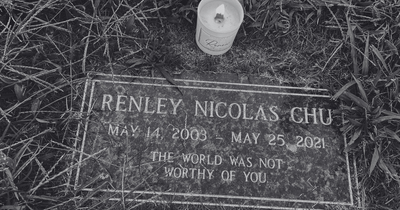
But Renley only lived until 2021.
That night, he called and texted my husband and me until I woke. All he would say was that he loved me, over and over, and he wanted to hear me. When I asked what was wrong, he said the doctor told him to talk to loved ones. He then insisted on giving me access to all his personal accounts, typing, “Want you to have everything.”
I knew, then.
The first few nights, I slept between my husband and my best friend, cradled between their arms. Together, we wept for the child who would never come home. My husband and I clung to each other as we wept the first time we walked past the bedroom we’d prepared for him. In the months and years after he died, I searched for every scrap I could find of our interactions—letters, text messages, Instagram messages—and gathered them together, printed them out.
The bulk of our conversations had taken place on Signal, which couldn’t be downloaded or printed, yet it was there we had our last conversation, there I spoke with him over the phone while he texted with waning frequency until they stopped forever. The messages after were mine alone: “Wake up. Wake up. Wake up.”
All of it disintegrated with the flickering, water-damaged screen when I tried to restore the chats onto my computer. Those texts, those memories were gone forever. I mourned him again, as if for the first time.
“I have nothing left of him,” I wept to my husband.
Without a word, my husband brought me the stacks of papers with Ren’s words, showed me his own Signal chat window with Ren still pinned to the top, right underneath mine. We read them together and laughed over Ren telling my husband to make me eat more than half a sandwich, cried over Ren’s last texts to him saying he didn’t want to die. I read my husband’s texts to Ren days after he had died, asking if he was there.
I will always regret losing Ren’s messages. Memories are not only in my phone’s archive, though. They live in Endora, who remembers and speaks of Ren with tenderness. They live, too, in my husband, who loves and misses him with me.
About Me: Tiffany Chu is a Taiwanese American writer based in San Diego. Her essays and short stories have been published by Open Secrets Magazine, San Diego Writers Ink, and Chicago Story Press. She writes about evergreen themes of grief, belonging, and what it means to be human. She's been writing this publication, The Untangling, since 2023. Order her books here.
No spam, no sharing to third party. Only you and me.



Member discussion