Orphan
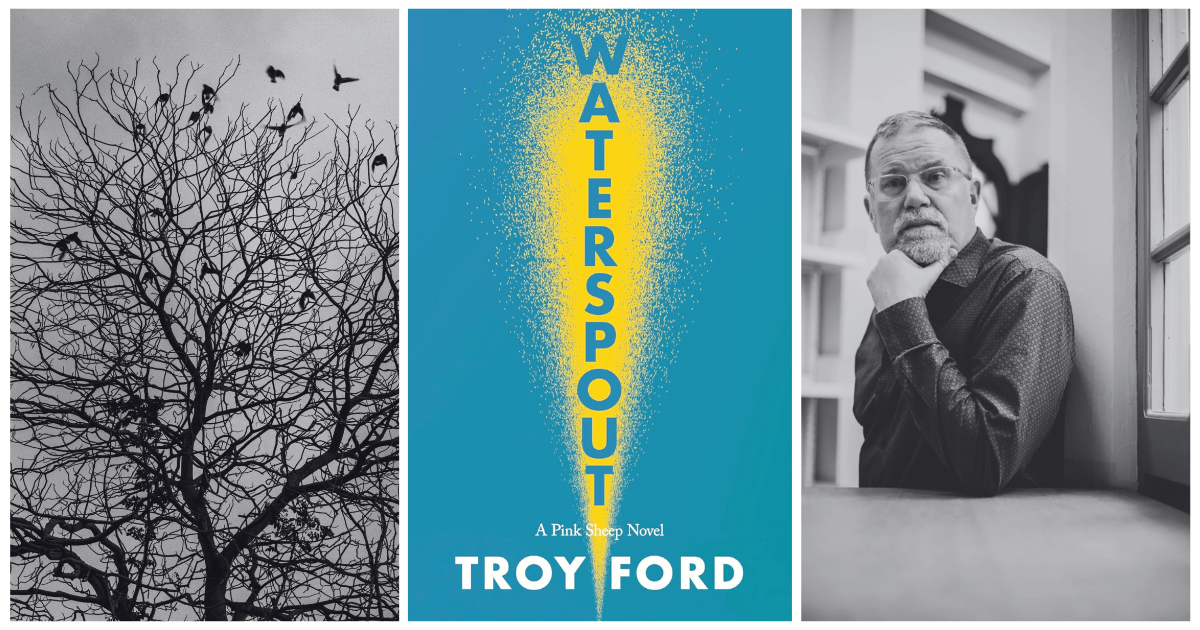
It's an honour to share Troy's story with y'all, especially as it's Ren's death anniversary today. I'm inspired by Troy on many levels—his author journey and community building, but even more so now, having learned what he's gone through to get to where he is.
Troy's new novel, Waterspout, is available for preorder now. I also recommend his first book, Lamb, which I had the pleasure of reading last year.
Note: This is the last of May's guest essays. I hope you've enjoyed them! I've scheduled a post for next week; after that, it'll be back to regular programming (as in, irregular lol). Thank you for allowing me the month to grieve and remember Ren. 🩵
My father died in 2007, my mother seven years later. 2014 was also the last time I spoke to my sister, who plundered Mom’s estate after obtaining power of attorney, sold the family home, and spent the proceeds on herself. I email one of my cousins at Thanksgiving and Christmas, though I haven’t seen her for more than five minutes in the last thirty-five years. The others—four boys on my father’s side, another two on my mother’s—have never had any interest in maintaining a relationship.
If asked, I say I have no family besides my husband and my dog.
It feels strange to declare myself an orphan, going on fifty-seven, but my sister and I were adopted, so for the first three weeks of my life, an orphan is in fact what I was. If this were a nineteenth century novel, a child given up by its parents might be placed in an orphanage and carry that identity for the rest of their life. But by the late 20th century in California, there was a state apparatus for putting stray children like us up for adoption. So I did have parents, but as time wore on, it became clear my placement with these particular two people was not a natural fit.
I won’t say our difficulties were any more grievous than might be found in biological families; my husband’s own was fraught with lies, betrayal, and violence which I never experienced. But despite the absence of that level of emotional warfare, something else was clearly missing; an attachment, perhaps.
Yes, there was food, clothing, shelter; birthdays and Christmas were celebrated. We weren’t rich, and my father’s career in aerospace was prone to periods of unemployment until he secured an overseas contract in Saudi Arabia where we lived for seven years. It was there, when I reached puberty, that I realized things were not quite on target with my sexuality, and some of the cracks in our family began to appear.
There were signs even before that. My mannerisms were worrisome to my father. I had a lisp, and my parents debated in front of me whether oral surgery would correct “my problem.” I did not enjoy sports. I threw like a girl, Dad said, and I was afraid the baseball he wanted to pitch back and forth might hit me in the face. I would flinch and miss the ball, and he would abandon our game in exasperation. When my little league baseball team—the one he demanded I join—came in last place for the season, the matter was quietly dropped forever.
I don’t know what our relationship would have looked like if I’d been the chip off the old block he clearly hoped for. He was a golfer, as were all his friends. I imagine if I’d shown even a slight interest in the game, the slow learning and perfecting of my swing might have proven the glue to a father/son bond. But I was awkward in most physical activities except the fluidity of roller skating with my little girl friends, and too self-conscious of the differences between me and most other boys to even try improving my skills. I was bookish; I liked to garden, but I got no encouragement from him there.
He spent years trying to suss out of me some kind of interest in girls. Birthday cards paraded the obligatory blondes in short-shorts, winks and nudges included. When I brought my friend Alice home from college for a visit, he was quickly crestfallen by our obviously platonic rapport.
The final blow came just as I was graduating. I had come out to all my friends already, but after I told my parents, their tolerance only lasted if I kept my mouth shut so they could pretend nothing had changed. When I couldn’t keep pretending with them, there was a rupture. After a five-year estrangement, I was able to reconnect with them by seeing them not as parents involved in my life, but as distant elderly relations more akin to grandparents.
When my father died, I stayed with Mom for a week so she wouldn’t be alone and kept myself busy by sorting through their disaster of a garage. They had inherited the hoard of my packrat grandmother, stacked to the rafters with bank giveaway toasters, back issues of National Geographic, and jars of buttons.
It was this same grandmother, my father’s mother, who we were always told had put some money aside for each of the six grandkids in savings accounts. Even at a modest interest rate, it would have grown considerably over twenty years.
But after Gramma died, the inheritance for me was delayed by several years around the time of our estrangement. I heard from my sister that she had received her share of Gramma’s money. After we mended our rift, I broke down in a time of financial duress to ask if there was any forthcoming for me. A check arrived quickly, but out of curiosity I asked my sister why, if this money had been growing in a savings account for so long, the original amount hadn’t grown?
“Oh. They didn’t tell you? Because Gramma didn’t set aside any money for you and me, only for the natural-born grandkids.”
And there it was: our grandmother had lobbied against our parents’ adopting children. In fact, that was the reason she and our mother often butted heads in the years after, because Gramma’s wishes went unheeded and we two changelings had been introduced into the family. She felt a clear distinction between children born by blood, and those taken in from who knows what kind of people.
In the end, the “inheritance” had come out of our parents' own pocket, and there was precious little to spare for reasons my mother revealed after Dad died.
It must have been the margarita. On the last night before I had to return home and work, Mom and I went to dinner at a Mexican restaurant and she began telling me stories about my father without realizing the magnitude of her revelations.
She told me the story of our last week before moving to Saudia Arabia in 1977; Dad had gone ahead for his job a few months earlier. One night, in the middle of packing and handling two kids on her own, there was a knock at the door. Two men in suits stood in the doorway. They knew her name.
“Ma’am, we’re here to collect your husband’s debt. We know he’s left the country, but he owes our employer $10,000 and you’re going to have to come up with that money before you leave too. We know where you live; we know where your kids go to school. We’ll be back tomorrow night at the same time, and you’d better have the money … or else.”
And so she went to the bank in the morning, cleaned out their checking and savings, and when the men returned the following night, she handed it to them without a word.
She also repeated a story a buddy of his had shared, about the time he and my father had gone out drinking one night after a late round of golf, and how, waking up from a blackout on a thin strip of desert highway, he’d asked Dad where they were going?
My father chucked his empty beer can out the car window and slurred, “We’re going to Vegas, baby.”
“Your father had a gambling problem,” she said as she finished that margarita. “He lost several fortunes over the years.”
In that moment, I also understood the odd encounter we had not long before his death. I had worked at a brokerage firm for many years, and he wanted my advice on an investment opportunity. Someone had called out of the blue about a boutique liquor brand “accepting” early investors. They had a thick package of marketing material heavy on glossy pictures of happy people enjoying their product but light on numbers and business plans. He mailed the package up to me in the Bay Area and wondered what I thought?
“Don’t do anything! Don’t give them any money!” I said, but by the time I arrived the next week for what turned out to be his last birthday, he’d already wired $20,000—their entire savings after a lifetime of work.
“But this is gambling!” I said to him in front of my mother, without realizing how loaded my statement was for them. He glanced at her and stalked off in apoplectic silence.
There were other disclosures on that night of seismic epiphanies over enchiladas. My father hadn’t wanted to adopt another child after my older sister. He knew how much my mother wanted children and found space in his heart for a little girl but didn’t want to adopt someone else’s son. He came around eventually and even named me after himself to try to codify the bond.
Once, my mother said, they were driving home and stopped at a liquor store. My father went in by himself and emerged with a flask-sized bottle in a brown paper bag. He went into the men’s room in the gas station next door, and a few minutes later, she heard a bottle smashing and Dad emerged smelling of the whisky he had chugged. Another time, he drove home so stumbling drunk he’d fallen in the driveway. On another night, hours late for a planned family barbeque, he arrived home so inebriated that he fired up the grill at one o’clock in the morning, unaware he’d lost six hours of time.
Perhaps the most gut-wrenching secret she told was the way he spoke to her near the very end. His heart had been failing for several years, and the lack of blood circulation to his brain had brought on dementia. At one point, frustrated by a pair of pants and shoes, he lashed out at Mom with a string of vitriol, calling her a bitch and lambasting her for “ruining his life.”
I felt awful that he’d treated her so badly. “That’s terrible!” I exclaimed.
“Oh, I didn’t take it personally,” she said. “I mean yes, it was awful, but I knew who it was really directed at.” She looked at me meaningfully. “And why.”
Stunned, I didn’t have the wits to clarify her statement at the time. For the last twenty years, I’ve carried the implication that he blamed her for being unable to have kids and forcing him to adopt a boy who turned out to be gay. And by the time Mom died of a stroke seven years later, dementia had also robbed her of the memory that she ever had a son. I felt erased.
Around that time, I mentioned to my therapist for the first time that I was adopted; it hadn’t seemed relevant before.
My therapist stopped me. “Oh! But that changes everything.”
Our parents had told us we were adopted as soon as we were old enough to understand what it meant, “just so there wouldn’t be any surprises,” and they’d insisted that it made no difference in the way they treated us. But perhaps I should clarify: our mother was the one who said this to us. I now believe that might not have been true for Dad.
Over the course of more sessions, we teased out some of the ways attachment in adopted children can become distressed, particularly in the event a parent fails to entirely bond or withdraws from a child. It can lead to chronic or acute anxiety, self-esteem issues, dissociative disorders—the very things for which I had sought help. My father’s long slide into disappointment and self-destructiveness resonated deeply through our relationship and my own sense of self. I have also struggled with substance abuse and depression; I am now sober.
Since then, this family history—my grandmother’s rejection, my father’s distance, my mother’s forgetting, my sister’s betrayal—has come to look less like incidental facts and more like a thread running through many of the challenges of my life. Our family hid cracks and fissures which each new pressure widened until the whole edifice crumbled.
I’d like to say there was a moment when all of this resolved—that therapy, revelations, sobriety, and time have brought me clarity and closure. But that isn’t entirely true. What I have instead is a story that makes more sense than it used to, and a word—orphan—that feels true, and not just as a metaphor.

Troy Ford is an author and editor, and the publisher of two popular newsletters: the writing-focused Ford Knows Books, and Qstack, an LGBTQIA+ Community, Directory, and Platform of newsletter writers and readers. As a creator and advocate, his mission is to give voice to queer people and issues by promoting their visibility through media projects and collaborations, and through his own fiction and essays. He has published two novels, Lamb and Waterspout, in the Pink Sheep series.
No spam, no sharing to third party. Only you and me.

Member discussion