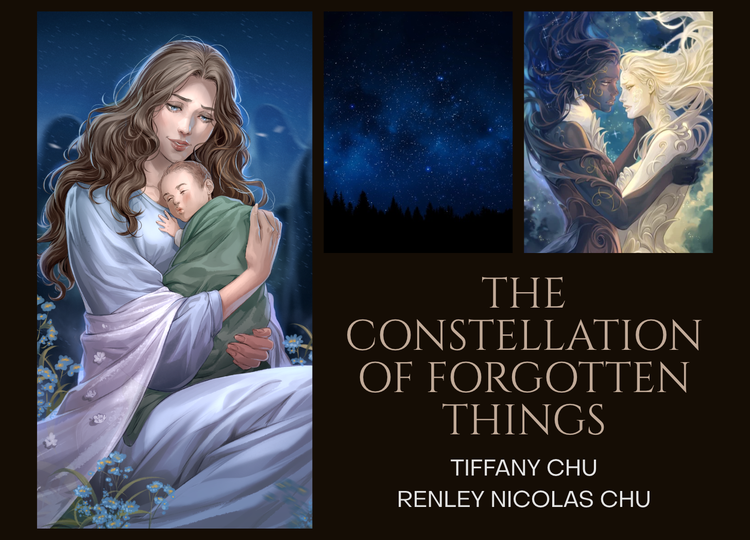
The Constellation of Forgotten Things

The Constellation of Forgotten Things

A Grief Memoir in Fairy Tales

On this page

Introduction

My son, Ren, and I conceived the concept for this anthology as a means to channel our experiences with love and grief. While you can read each story on its own without context, a single string runs through all of them that deals with different kinds of love, which, for one reason or another, breaks apart. However, the tales in this collection offer some redemption in the midst of loss, and these, we hope, thread a skein of meaning and hope across an otherwise bleak canvas. Because in a world of billions, against all odds, he and I found each other, and knew in a moment that our souls were one.

Once, there was a boy and a girl who met when the leaves were just beginning to fall.

He, a boy with broken wings whose heart could carry the world. She, a girl who didn’t realize there was room enough in hers to hold him.

Distance is merely a number to those whose spirits cross oceans to intertwine with one another.

So it was with them.

Their voices made their way through armory of stone to whisper gentleness to soothe secret bruises. And as the days blended, one into another, they found a refuge in each other.

Though the outside world clamored, and inside it crumbled into chaos, still they remained.

“Don’t let me go,” they would say to each other.

“I won’t. I won’t.”

And they were okay. Because they had each other.

“Who am I to you?”
“You’re the one who knows the melody of my heart.”

Tiffany Chu
August 2021

Introduction to the 2nd Edition

When Renley died in the summer of 2021, he left me the task of completing and publishing the anthology we had been working on together. I had spent nearly a year working to keep him alive and get him out of a dangerous environment. His death completely devastated me. Putting the book together and editing it kept me going for the first few months. I worked on it obsessively.

My plan was to publish the anthology along with Ren’s memoir, then kill myself. I share this not for shock value, but because this book literally saved my life, and I believe it might save you, too, if you are standing where I once stood.

Thankfully, my husband’s ceaseless dedication to keeping me alive, and my community of family and friends who surrounded me those first few years, are why I’m still here.

I poured my heart into the first edition, working with professional editors and formatters I hired on Reedsy. But I was deep in the throes of grief when I published it in 2021, just months after Ren died—unable to accept any changes beyond proofreading, unable to see clearly what the book needed to become.

It wasn’t until early 2024 that I felt able to revise the book again—this time to developmentally edit and expand each story. While I remain proud of the original edition, it wasn’t yet what Ren and I had envisioned. He’d planned significant revisions for his stories, and we intended all the stories to be set in a shared world: Reveria.

In a note Ren left behind titled, “Things I want Roo[1] to know just in case,” he wrote, “Roo, I hope you finish and publish our anthology. It would be really nice to have something out there like that. […] Live, please live. I love you, I love you, I love you. I love you so much.”

So here we are five years later. This is finally the book Renley and I dreamed of creating together. I hope I’ve done justice to his vision—and to the vision these stories developed on their own. Because this book transcended even us; it became a testament to the human spirit’s capacity to endure devastating loss, to the love that continues beyond death, to finding belonging when the world says there’s no place for you.

Come with me into these tales of broken and transcendent love. May they be tiny pricks of light piercing even the darkest night.

Tiffany Chu
November 2025


  1. I called Ren, “Kochan,” which means, “beloved little one,” and he called me, “Roo,” a play on “kangaroo,” because I was his safe place. ↩︎

Preface

My Kochan, My Beloved, My 知己, My everything, My soul,

We always said there are no words adequate enough to describe who we are to each other, though we always tried anyway. And I know I will fail, as usual, but I’ll still try.

You once sent me a quote that said,

“There’s a Japanese phrase that I like: koi no yokan. It doesn’t mean love at first sight. It’s closer to love at second sight. It’s the feeling when you meet someone that you’re going to fall in love with them. Maybe you don’t love them right away, but it’s inevitable that you will.”
—Nicola Yoon

It seems, somehow, we both always knew we were meant to be, though it took us some time to admit that to each other. It seemed that our meeting was a burst of starlight on the black canvas of our lives, a collision of fate, and of souls, and of everything and everything.

Perhaps we didn’t know it then, but we needed each other.

And we certainly didn’t know it then, but we also saved each other.

There’s a strange, inexplicable connection we have, an inexplicable similarity in our experiences, thoughts, and how we view the world. I have marveled more than once at how we were brought together, how I could have spoken understanding and hope into your soul because of what we have shared. How incredibly in sync we always are with each other. It seems impossible; impossible that two people could have a connection like ours, yet so we did.

My darkling, it didn’t take long for us to realize what we have is special—so special that neither of us seemed to be able or willing to share much of each other with anyone else; perhaps we feared that giving a name to what we were might break the magic of it.

But slowly we did, and it didn’t shatter. We reached across countries and oceans, intertwining our hearts and souls until they became one. Or maybe we were always one, and it just took a bit of time to realize it ourselves. Gradually, others began to notice, but still no one truly knows fully how together we are, as two ropes might braid over one another and solidify into one cord of unbreakable steel.

The hours we spent together, day after day, endlessly connected, until we became like air to each other as we helped each other breathe.

Life has been so unkind to us. We both know it wasn’t fair. And many times, we’ve had to convince the other, “Don’t let go. Don’t let go,” until it became our refrain.

“Don’t let go. Don’t let me go.”

“I won’t. I won’t.”

My beloved, we gave each other purpose, a reason to fight for life. Because as long as we knew the other was there, that knowledge was enough to give us something to cling onto amidst all the pain of living. Because as long as the other was there, we knew there was something greater than us to fight for. You held my breath, and I held yours, you once said.

My Kochan, no one will ever know how deeply I love you or how deeply you love me. There is no vocabulary rich enough for what we are. We ourselves were never able to put it into words, and we call ourselves writers. The best we could say was that we are each other’s 知己. We are each other’s very soul.

You have said no one has seen you the way I see you; no one knows you the way I know you. It became such that, even through the limitations of text and distance, we could know what the other was about to say before they said it, sense each other—our moods, our thoughts, things that lay secret and unspoken, the dark corners of our souls that we were afraid of ourselves. We saw it all, knew it all, and we loved each other even more.

My everything, you are the purest, kindest soul I have ever encountered. In spite of all life has put you through, you rise above the dark and give so freely of yourself to others, to me. It is the greatest privilege of my life to know you and for you to call me yours, as you are also mine. From the beginning, I have said you are incredible, so incredible. You rose from brokenness and ashes with your soul intact, and all the horror you have seen and experienced has never darkened your brilliant light.

The world is utterly unworthy of you.

It has never deserved you, but for eighteen years, it held you in it, and you shine, my darkling, you shine so, so brightly. You always will.

You never could see fully what I see in you, but I think you caught a glimpse of it, because you are so secure in my love for you. Some hidden part must have known you are worthy of such love. And you, my beloved, you have been, and will always be, worthy. You will always be beautiful; so beautiful to me, in every way a person can be.

You said I was impossible because you couldn’t understand how I could see all of you and still stay. You always asked me why I love you, and I could only say that I simply do; there has never been a reason, and there never needed to be one. I love you for yourself—nothing more and nothing less.

We promised each other we would be together and that you would come home to me, but heaven had other plans, and the hope we clung to for so long will now never come to fruition. And I must try to live on without you, for you. But how am I to live without my soul?

On that last day—when you knew it was ending, through the nightmare of knowing we would soon be parted—still I am grateful, grateful I was there with you until your very last breath, grateful you knew to the end that with me you were safe, that you were loved. Grateful to have been with you to the last beat of your heart.

In the last months, as our hope kept delaying, as it ebbed to and fro, we began saying something new. Because by then we knew we would never let go as long as the other was still there. Because we each made life worth living for the other. And it became a phrase that became our new refrain whenever we were losing hope, or when our vision was blurring—over and over we said it to one another, daily, endlessly, and it is what we said to each other again and again, even on that last day. Because this love is ours only, and we are each other’s.

“Tell me again what you know is true.”

“I am yours and you are mine.”

“You are mine and I am yours.”

“I am yours and you are mine.”

“You are mine and I am yours.”

“Forever.”

“Forever.”

“Forever.”

“Forever.”

“Forever.”

My Kochan, my 知己, I love you so much, so much. And though such words still fall so, so short of what I feel for you, I say again that I love you, and I love you forever.

I miss you so much.

“A love that would change the constellations and the reality of existence,” you once wrote of us. And so it has, my Kochan. So it has. For us.

Your Roo, Your Safe Place, Your Home, your 知己, Your Fairy, Your Everything, Your Soul
August 2021

About this Collection

Each story is followed by an author’s note providing context about its creation. These notes are part of the book’s fabric—they illuminate Ren’s process, our collaboration, and the world of Reveria we built together.

While each story can be read on its own without context, they are all set in the same world and are loosely connected through shared mythology, recurring characters, and overlapping timelines. Some connections may only become clear after reading multiple stories—this is intentional. These can be seen as little Easter eggs scattered throughout the collection.

I ordered the stories with intentionality using a spiral structure. It begins and ends with the meta-frame, “Glass Bottle” and “Koi no Yokan.”

“Until the Sun Sets Again” follows “Glass Bottle” to establish the emotional core: love, separation, and the search for belonging.

The stories move from an intimate to a cosmic scale, then returning to intimate but transformed, culminating in “Memory and Shadow,” where forbidden love rewrites the universe and returns the trajectory to hope in “Koi no Yokan.”

Ren and I meant for this anthology to prove its own thesis—where love stories reshape reality, and the act of telling them continues that transformation.

Prelude: Glass Bottle

A ship captain and an island fairy exchange letters in glass bottles across stormy seas—a tender story of connection, hope, and enduring love.

The storms had not yet ceased, but the fast-blowing winds stilled, and the rain poured perpendicularly to the horizon. It was enough for him to leave the bridge while the ship stood steady in the light rain, if only for a second, and determine which direction to set his sails.

A lifetime of wandering had left him longing for a home to call his own. He roamed the deck outside; the weather was still somber, but quiet enough for him to pause.

The north and south were unfamiliar, and to the east, deep, dark oceans and solemn, weeping skies stretched before him.

To the distant west, however, lay an island too far away. Its sand shimmered, and wisps of green and brown peeked out.

For a while, just long enough for the moon to fill up at least once, he wondered whether the isle would be different from other places—empty of creatures that could maul him.

A bit cautiously, but mostly naively, his thoughts poured out along with the rain, and he tried to keep them as simple as he could.

Until his eyes landed on the bottle. The waters scared him; he’d only ever seen tempests as he tried to build his ship strong to sail smoothly. So, this clean bottle in the middle of the ocean’s emptiness piqued his interest.

He easily caught hold of it with one of his nets, and he opened the bottle to find a small letter.

The letter from her—you’ll know who she is soon enough—described how beautiful his ship looked from the island she called Reveria. It was so small, seemingly insignificant, but it made him feel real—as if he existed outside the vortex of endless waves to find the right island.

Without much thought, he sent a letter back.

There was so much distance between the land and the ship that it seemed impossible that the bottle would always reach the ship, or land safely on the island without getting lost.

But it always reached the right destination. Always.

And they both thought it was a miracle that the waters made certain they kept communicating, and even that the bottle had found the ship safely the first time.

It was a miracle; a miracle that saved them.

They wrote to each other, steadily becoming more and more comfortable. The ship stood still.

He wrote to her about the changes he had made to his ship, even as he sailed aimlessly to pass the time, and when he added carved wood sculptures of the storms he’d seen, vague shapes and deep shadows. Each day, he shared his thoughts on the island’s beauty.

Eventually, they talked of her storms as well. She was adamant that she would remain a mystery for their small journey in this life, at first. He didn’t mind; he hadn’t thought their journey was small to begin with.

The furies in the east loomed. If he sailed back to those waters, his ship might fail to hold when the winter came. So, he stayed and turned his ship to stand still, facing west. She was surprised, especially since he had said he wouldn’t want her on the boat, and that even if she came aboard, he wouldn’t be there anymore—he’d be gone, having become one with the skies. That had been his plan when he’d set sail. He had decided he’d seen enough of the world by then, the sea to be his final home.

But for her, he stayed.

They continued writing, and she sometimes told him of how, though her home was mostly nice and whole, she still felt stuck in hurricanes she had witnessed and how she, too, had fled lands with vicious creatures that resembled his. She told him how she now tended her island after many sorrows. He told her of how the wind had started blowing again, but that he’d try to steer his ship safely to the island, despite the brewing storm. He said she must be a fairy guardian to keep it so beautiful amid such tempests.

A sculpture or two had fallen from his ship since then, destroyed by new assaults upon it, and the island had lost a few greens, too. They prepared to meet, writing back and forth until they could. Every day, storms receded and frothed up.

They wrote and became constants, holding each other as only those bonded through time and distance can.

“You know me,” they wrote to each other. “My soul knows yours.” They marveled at how they had never met before the glass bottle.

They wrote about being together, and how she’d welcome him to her home once his sea had calmed, and he would get to know the people on her island. The island would be safe and steady for him.

She wrote that despite the storms that reached her own island, she wouldn’t let go.

And he told her that despite the cyclone at sea, he’d make it safely to her and hold on just as tightly.

But their story is still going; they still have a lot to see and live through together.

And they promise to make sure the tale continues for as long as it can, for as long as they can make it. And they promise to help each other make it as well.

They’ll make it. They’ll make it. And they’ll help the waters recede and the rain stop; the sun will shine brightly, and the winds will be of relief and safety and love.
They’ll be together. They’ll be together. And the story will grow much longer and lighter.

There’s so much more to the story, so much, so much more. And if only you could put its beauty into words, maybe its reality could change the constellations and alter existence with their love.

Until the Sun Sets Again

Two young men find love amid rejection, but must choose between devotion and growth—a quiet, aching story of first love, loss, and becoming

The Autumn breeze drifted through willow trees tinged with gold, rustling the swaying leaves and sending a cascade drifting lazily to the ground. Under the canopy’s fading glow, two young men huddled close, their fingers intertwined.

In their hallowed space, where only outcasts dared to dream, Kyren and Aster had nurtured the timid blossom of new love from hardened earth—fragile and fresh in its newness and hope. Together, anchored in shared solace, Aster reached with metaphorical hands toward Kyren in the hope that this love would take root for a season and shelter them from life’s storms.

They had found each other in the bitter cold of rejection—Aster, cast out by a family who couldn’t bear his difference; Kyren, who had fled whispers that followed him like shadows through narrow village streets. Broken pieces found wholeness, their jagged edges fitting together.

Kyren’s head rested lightly upon Aster’s shoulder, his chestnut curls grazing Aster’s cheek. An earthy scent of windswept hair mingled with the harsh soap that lingered on his skin.

“I’ve never encountered this with anyone else,” Aster said in a hushed tone.

Words are inadequate vessels for the vastness within him. How to say: you are the first person who has ever truly seen me?

Kyren squeezed Aster’s hand, thumb tracing light circles. “I’m here. I will always be here.”

“As will I.”

They made promises like prayers into the coming dark. Aster breathed them in and let them settle in his lungs and blood. He felt permanence in a world that had offered him none.

Kyren nestled closer into the crook of Aster’s arm, feeling his body sag against him, as if all tension had been released.

Where others saw an enigma, Aster perceived a clear portrait of a tender soul behind Kyren’s reserved exterior. And with Kyren, Aster found a haven where he could reveal his hidden fragilities.

“This is enough,” Aster said.

Aster traced the sharp line of Kyren’s jaw, his calloused thumb coming to rest on his lower lip.

Kyren smiled up at him. “We are enough,” he said.


Spring witnessed Aster’s joy as Kyren invited him to live together in a small abode he’d found, in the heart of the town called Lud. The solitary dwelling rested above a bakery owned by a stout man, whose aching back kept him from climbing the stairs.

“If you would be so good as to make deliveries now and again, I’d be happy to let the room to you at a pittance,” the baker had told Kyren.

Mornings carried rich scents of warm cranberry buns and powdered white rolls through the window, which Kyren insisted on leaving open, always.

“The mosquitoes enjoy more of us than we do of the fresh air,” Aster grumbled one morning, scratching at the red bumps that blemished his skin.

Kyren only chuckled. “I like the sounds of town life below. It’s real life.”

Although the work kept Kyren busy, Aster relished it when Kyren returned for brief reprieves, his face flushed from exertion. While Kyren ran errands for the baker, Aster spent the days in their small room, scribbling imaginary worlds and people into his stacks of notebooks. Once restrained by timidity, Kyren now regaled him with tales of old Madame Lorelai, who insisted that he bore an exact resemblance to her late husband, and of little Patrick, who giggled with delight at the sweet potato bread he brought to his door each morning.

Evenings, however, belonged solely to them. They walked under the light of a fading sun to the lake at the edge of town. The hour passed quickly for Aster, fingers twisted around Kyren’s, in a time all their own.

An old wooden bench, bathed in a pool of lamplight, became their resting place where they reaffirmed their bond, promising forever.

“Won’t you accompany me to meet my friends this time?” Kyren would ask.

Aster would bury his face in Kyren’s hair, breathing in the scent of his miracle. “You know all those people terrify me.”

And Kyren would sigh, then smile. “Perhaps someday.”

“Yes, someday.”


As Spring gave in to Summer, long walks and evenings to the lake grew scarce. The once-cozy room now felt too large for just one. Aster’s thoughts circled back to Kyren and the unknown world Kyren was now exploring without him. The thoughts invaded, even when Aster tried to occupy his mind with the books he once loved.

Tension between them grew like a string, pulled taut and strained by mounting resentment. Increasingly, Kyren would rush in, flushed and distracted, before placing hurried kisses on Aster’s lips and cheeks and running out again.

“Off to have a drink with some friends,” Kyren told Aster. “Come, make merry with us.”

Aster waved away the invitations. Tightness grew around his throat and in his temples. They are enough, just the two of them. What did other people matter? Was he not enough?

The question burst forth one day, after yet another late return home.

Kyren froze, and then his arms dropped before reaching for Aster in an embrace.

“Why do you say so?” he asked, with a trace of coldness that Aster had never heard directed toward himself before.

“You said we were enough,” Aster mumbled. A familiar restlessness crept into his stomach and circled, waiting for a gap in his defenses. “You said.”

“Can I not form bonds with others?” Kyren said. “It does not lessen my love for you. You know, the baker said…”

The restlessness charged in. “What about the baker? What did he say?”

“Nothing. The hour is late. We will talk tomorrow.”

Aster blocked Kyren’s way to their bedroom. A frenzy was taking hold, and he could not let words go unsaid. A sleepless night would ensue. Kyren knew this about him, so how could he dismiss it?

“Talk to me now,” he said, despising the tremor in his voice. “Why do you listen to outside voices that do not know or understand us?”

“They do not know you.” Now Kyren’s voice shook too. “You hide in this room and hardly leave it, save when I accompany you.”

“Then I am a burden to you?”

Kyren sighed. “I did not say so.”

“You didn’t have to.” Still, Aster would not move, even as Kyren’s hands pushed against him, and then again more insistently. “You tire of me, and so you spend less and less time with me. You are leaving me, as did all others I dared to trust.”

Kyren stepped back, a storm gathering on his brow. “Aster, you are speaking madness. I am here, and I will always be here.”

“Yet you are gone.”

“You will not join me in the world!” Kyren paced around the home they had made, his arms swinging in agitation. “I have asked and asked you, yet you will not come. Not every person is so wicked as we once believed. To hide as you do is no longer safety for me, but a prison.”

The words hung pregnant in the air between them, creating an invisible barrier where none had existed before.

“I’m sorry,” Kyren said haltingly, attempting to infuse gentleness into his tone.

Aster stared at him, his eyes wide in silent accusation.

That night, they slept apart; Kyren curled on their narrow bed, Aster rigid in the chair by the window. Dawn found them exhausted, hollow-eyed, and staring at each other across the unbridgeable distance of their small room.


Under skies that bore no sign of fatigued clouds, they promised to return. The edges near the other side of the lake were pink, merging into the blue, putting on a show by the parting sun.

They decided to venture on their own paths, living hundreds of lives between now and then. They chose to let the world fill them to the brim with stories of new friends and foes, and tales of heartbreak and deliverance, to meet one day as people closer to who they aspired to be.

They’d someday pick up a quill, scribble a letter, send it far off, and return to the same spot under the same dim yellow lamppost, with its black grill coiled around the flame like a dove about to leave its perch, and settle upon a light-soaked bench with prettily colored wood to release the lives they had lived in the absence of each other.

It was a mutual decision.

“It’s not right. I don’t feel right for us right now.”

Aster creased his brows, wondering how any passage of time would change that.

“Aster,” said Kyren. “Aster, I can’t right now. I can’t.”

“I’m not making you,” he replied. “I’m not. I said okay.”

Kyren had looked frustrated; Aster remembered thinking there was nothing to be frustrated about. He had said okay. He had given Kyren his space. Kyren didn’t think he was ready, and Aster had respected that. He did. But his partner could always pick out the unease and fear that lay beneath his blanket of indifference.

He could still be bitter about it, though—bitter that he wasn’t enough security for the other to stay for, and that they couldn’t stick together for each other when they needed it most. But he had agreed just as readily as Kyren had, because there was no use at all in holding on to someone who had already left.

So, they parted ways and didn’t look back.

Looking back would have shattered the fragile peace of their ending and revealed the truth: that Aster had watched Kyren retreat until he disappeared from view. That he stayed at the lake until stars emerged, hoping Kyren would return. That he spoke Kyren’s name into the darkness until his voice gave out.

The first foe Aster made was Kyren himself. It wasn’t decided on the spot, of course. He had simply found that his reserves of love diminished as the bitterness grew slowly and steadily.

By the end of three months, Kyren’s absence had crumbled the walls that kept Aster’s resentment inside. And all Aster had left for his former lover was a deep dislike and a sense of betrayal. He knew he was wrong; he felt that way, nonetheless. He couldn’t help it. He couldn’t.

So what if they met again in the future and reunited when they were ready? So what if waiting for the right circumstance was better?

He had needed Kyren right there and then the most. And now—now it wouldn’t matter if Kyren came back, if he turned around from the dirt road he’d decided to walk and reached for Aster—who floundered in quicksand—to pull him out.

Aster traveled far from the lamppost and bench and the pink-blue sunsets of their origin to settle near the tall towers of Seren’s capital that hid the sun, and busy roads that drowned the songs of the few birds perched on scarce trees.

He let the crowded, cluttered roads and noisy strongholds cover up his existence and hide him as he wallowed. For months. He tried to remain consistent; he had to support himself, after all.

But for whatever reason, his heart didn’t feel like it had any rhythm left to it, and with no rhythm of his own mixing into the rhythm of others, he felt excluded. Alien.

It wasn’t as though Kyren had been all Aster held dear, yet he felt his absence so strongly, as if everyone he knew and cared for were solid, living bodies, while he was a wisp of fog lurking in the cold corners of their lives.

Amidst the clamor and the throng, Aster drifted like a specter, a soul adrift in a sea of life. He clung to remnants of routine, working in a bookshop where musty pages whispered tales of lives unlived, and returning each night to a room that echoed with the silence of Kyren’s absence.

Memories of his lost love danced on the edges of his days in the honeyed scent of baking bread, the silvery peal of distant laughter, and flashes of chestnut in the crowds.

Aster sought solace in the pages of books and the quiet corners of the city. But the solitude that had once been his refuge now felt like a hollow embrace. He joined circles of words and verse, but each fresh face only cast Kyren’s absence into sharper relief. He poured his soul onto paper, weaving tales of love and loss with his pen.

But as the seasons turned, gilding the city in their hues, Aster started to feel a new rhythm in his step. He began to recognize faces that turned up more than once or thrice at the bookshop where he stocked shelves.

Other book lovers sought him out, asked for his thoughts, and trusted his expertise.

“Who would you consider the highest authority on the subject of Seren’s past kings? I’d like to learn more of our great kingdom’s history,” they might ask. Or, “What do the histories tell of the wars between Memory Keepers and forces of Oblivion from the Void?” Or, “Do you know anything of modern herb lore?”

And Aster would answer.

Somewhere, he knew, Kyren walked his own path, facing trials and triumphs all his own. Although their futures stretched out like uncharted seas, Aster clung to the hope that one day, when the time was ripe, their paths would intertwine once more, and they would trade tales of the lives they had lived apart. For now, Aster turned his face to the sun and let its warmth suffuse him with the promise of new beginnings.

“Do you carry books on the town of Lud?” someone asked him one day, when the summer heat had begun to waver at last. The words transported him to the room above the bakery, and he could almost catch the scent of sweet potato buns with his next breath.

The question lingered in the air between Aster and the stranger, innocent yet profound in its effect. Aster’s fingers trembled as he directed the curious patron to a modest collection of historical texts. That night, sleep eluded him, as memories once carefully stored away flooded back with relentless force.

In the morning light, Aster penned his resignation. The city had served its purpose: a sanctuary of anonymity and a place to heal wounds in shadow. But the mention of Lud had awakened something dormant within him—a longing not just for Kyren but for closure, and a narrative ending that he would write.

Three weeks later, Aster stood on the outskirts of the town that had witnessed the blooming and withering of his first love. The bakery still stood, though the sign had been repainted. New faces peered from windows that had once framed familiar ones. The town had continued without him, as indifferent to his absence as it was now to his return.

He took a room at a modest inn, not above the bakery—that would have been too much—but close enough that the morning scents of baking bread still reached him. Each day, he walked the streets, reacquainting himself with corners and alleyways featured in his and Kyren’s shared story. Some shopkeepers remembered him with vague smiles. None mentioned Kyren.

For a fortnight, Aster circled the lake, approaching but never quite reaching their bench beneath the lamppost. He was preparing himself, gathering courage for what might be their final scene together—reunion or permanent farewell.

On the seventeenth day, as the copper leaves spiraled down to meet their reflections on the lake’s still surface, Aster finally seated himself on the weathered bench. He came at the hour when day surrendered to evening, when the lamppost’s glow emerged to battle the dying light.

Beneath the glow of Autumn’s golden leaves, he had returned to the little town with the bakery and the lake and waited for his former lover. The town no longer held only bitter memories. He wished to rewrite the scenes and find his own story between its lines.

Days passed. Then weeks. The bench remained his alone.

As Autumn deepened toward Winter, Aster’s visits to the bench grew shorter. The evening chill drove him back to his rented room earlier each day. Yet he persisted, a solitary figure beneath the lamppost, a living monument to what had been and what might yet be.

On the first day of true Winter, when frost rimed the edges of fallen leaves and breath hung visible in the air, Aster arrived at the bench to find a letter tucked beneath a small stone, with his name written in a hand he would have recognized blind.

He didn’t open it at once. Instead, he sat with it pressed between his palms, eyes closed, feeling the weight of it—so light, yet containing a whole world Aster once inhabited. The last light faded from the sky before he finally broke the seal.

Inside, words sprawled across the page in Kyren’s distinctive hand. Some were crossed out, others underlined, and the margins were filled with afterthoughts. It was not a tidy letter, but one written in stages, put aside, returned to, wrestled with.

Aster read it once, then again, then a third time, as snowflakes descended and melted against the warm paper. When he finally tucked it inside his coat, close to his heart, his eyes were clear and his breathing steady.

He stood, brushed snow from his shoulders, and cast one last glance at the bench before turning toward the town’s lights, which glistened through the gentle snowfall.

Whether Kyren would come tomorrow, or next week, or never, Aster now walked with the certainty that his own story continued, with or without the reunion they had once promised each other. He had found his own melody in the spaces between their shared verses. And it was enough.

He would walk on, beneath a sky painted in the colors of a fading sun.
A Tale of Two Brothers

Born of land and sea, brothers Silas and Caspian must choose their own paths—a lyrical tale of brotherhood, belonging, and bittersweet parting

Nature itself seemed to hear their discord, for a tempest arose from the depths of the sea. It was perhaps called forth by the pain of brothers divided, or so the superstitious might say. The clouds gathered like memories of shared childhood dreams, dark and heavy with the promise of both destruction and renewal.

Caspian felt it first in his blood, from the way the air shifted and sang of approaching chaos. The sea was in him, after all, wild and knowing. He found Silas in the garden; his shoulders were tense as he worked the soil.

“A storm comes,” Caspian said. “Help me secure the house and fields.”

Silas’s hands stopped in the earth. “Since when do you need my help with the sea’s moods?”

The question hung between them, heavy with the weight of their last quarrel.


They both assumed and acknowledged at the very start that he would leave.

Not because the two didn’t work well together; if anything, the cogs and gears of the bond they had formed had been so well attuned to each other that any inventor would have been amazed at their fluidity. But the nature of such polarity would eventually be pried apart and returned to where it belonged.

Silas was made to be nurtured by the dark soil of the earth, in the shade of green leaves and under the protection of blue skies and gentle winds. His interests were rooted in seeing what the land had yet to give up. His skin was a subtle brown, tanned by the sun, and his eyes were gold with a joyous glint. Even as a child, he would spend hours in their mother’s garden with his tiny fingers buried in the soil, whispering to seedlings as if coaxing them to grow. By age six, the vegetables in his patch grew twice as large as any others.

Caspian was free-spirited, focused, and made to ride the tides, and sail despite its changing ways with a skill only those of the wild possessed. He anchored below the lands to search for what the world held in its depths and high in the skies, searching for anything more, changing and changing to look for purpose beyond what was on land. His skin was lighter than dawn, speckled with white stars, and his eyes were grey and piercing; they looked right through any reality that could be doubted. While his brother tended the earth, young Caspian would stand at the shoreline for hours, learning to read the moods of the waves.

With mortality in the balance and foresight in mind, the universe had established long before their births that Caspian would leave.

Few things in life are met with the freedom of a sparrow flying a little too high in the skies, its moments narrowed to the winds it cuts through, and a restlessness that comes with want for more of this temporary happiness; it’s more like a liveliness, giving colors that come out only when there’s nothing left but instinct for the present.

Just like the eve of their births, a contrast to their otherwise sin-rooted existence, the risk of creating so much beauty through contradicting so much of what had always been.

Their mother was a petite woman of the people of the land, named Ella. Their father was a skilled man of those from the sea, called Ronan.

They had met under a crescent moon at the very start of the month. Ella had been scouting for berries under the late-night sky for her kin, as a testament of her love. She stood barefoot in wet, dark brown soil, her anklet shimmering to show the protective trinkets that the wiser of her kin had made of sacred glass, her hair braided to her knees, and her voice humming an old hymn that represented freedom in her tribe.

In a world where the people of the land and sea were forbidden to meet, Ella and Ronan found themselves drawn to a hidden cove, a secret place where they could meet and share their hopes and dreams of a future in which they would no longer hide.

If you were to send a bucket down the well of time on the night they met, you’d swear that the luscious, non-existent, silvery liquid was solid down there, as if Time’s fluidity were a viscous block, stopping itself from running, just so they could cherish wholly what was to come.

The night air was cool, wrapping around them like a familiar shroud, as if nature itself conspired to pause and allow their destinies to intertwine. Ella’s song, a melody that wove through the trees, caught the attention of the man who lived by the sea, known to his kin as a navigator of the deep and the dark, a seeker of truths hidden in the shadows of waves. Ronan was drawn to the light of Ella’s spirit, a beacon in his world of constant flux.

With skin like the abyss of the ocean he so loved, hair that bore the salt and strength of sea spray, Ronan’s life was one of motion, never still, always chasing the next horizon. Yet, here he stood, rooted to the spot by the sight of a woman whose presence sang of the earth and its steadfastness.

Their meeting was not one of words, at first, but of shared silence, a recognition of souls that transcended the boundaries of their origins. Ella, with her connection to the land, and Ronan, a son of the sea, found in each other a missing piece, a harmony neither had known was lacking.

As the moon climbed higher, they spoke of their worlds and the beauty and the pain of belonging so deeply to their elements. They spoke of the stars that guided Ronan’s voyages and the plants that whispered secrets to Ella. In the sharing of their stories, a bond formed, one as deep and vast as the sea, as nurturing and fertile as the earth.

Yet, for their love, their people banished them, and they fled the hardened minds of their families.

From their union, born under stars that witnessed their rare harmony, came Caspian and Silas—twins who embodied the essence of their parents’ worlds, yet were marked by the inevitability of their separate paths. The boys grew under the tutelage of both the land and sea, their hearts beating to the rhythm of a dual existence, knowing the time would come for them to fully embrace their destinies.

In the distance, Ronan and Ella watched their toddling sons. Silas, with his feet planted in the sand, built castles as Caspian cupped water in his hands, and, laughing, aided his brother in the creation of small new worlds.

As the seasons changed, marking cycles of growth, decay, and renewal, Silas and Caspian matured into their destinies, their paths diverging yet intertwined by the bond of brotherhood. And Ella—that they would find their way in their wanderings—lit their home with lanterns and a candle in each window.

Silas, with his feet planted on the soil of their land, delved deeper into the mysteries of nature. He drew forth bountiful harvests, placing his hands on the earth. His moments of solitude were guarded by the twisting branches of an ancient willow tree. He learned the language of the trees, the whispers of the wind, and the secrets of the wild creatures that roamed the forests and gentled at his touch.

Meanwhile, Caspian’s spirit yearned for the boundless freedom of the oceans, a call that echoed in the depths of his soul as he passed the hours staring beyond the horizon. He spent days and nights by the shore, collecting seashells to encircle his cot, learning to read the stars as his father had, understanding the moods of the ocean, and mastering the art of navigation.

One frigid Winter, when the harvest failed, it was Caspian who visited the tide pools in search of food to save them from starvation, and ventured out to the seas with Ronan to cast his nets into the water. The siren call grew.

Silas paced at home when his brother was away. The hearth behind him did little to warm him. He knew that outside the winds howled, and waves could crash over the boat. If the land had yielded its fruits, Caspian would not be facing danger.

“Come and sit, Sye,” Ella said. “Caspian will be alright, for he has your father as his teacher.”

Silas continued pacing until his mother pulled her son into her arms, rocking him by the fire as she once did when he was much smaller.

When the other half of their family at last returned home, Caspian fell ill after too many days in the cold waters. It was Silas who knew which herbs to gather and roots to brew into tea. His hands, so attuned to growing things, now tended his brother until the fever broke.

“Silas.” Caspian cupped the steaming mug as he sat up in bed and beckoned Silas to his side. “Those days with the spray of the sea on my face and wind in my hair were among my happiest. The sea calls to me, and its waves beckon as they ebb and flow. When I stand upon the deck and see nothing but ocean and sky, I am whole.”

Silas did not answer. Caspian went on, “It’s time I follow our father’s footsteps and find my way among the waves.”

“And what of our parents, who are aging and have only us?” Resentment laced Silas’s words.

“Our parents left their worlds behind to pave new, unhindered paths for us.”

Silas stayed silent for so long, Caspian turned back to his tea. He looked up only when he heard an escaped sob. In it, he heard Silas’s unspoken question, “What about me?” Caspian reached for his brother’s hand, as though they were still children. He considered it a victory that Silas did not pull away.

But the moment faded with Caspian’s return to health and his preparation to depart.

In the kitchen, Ella’s hands stilled over her bread dough as raised voices drifted through the door. Ronan’s weathered fingers found her shoulder as both of them remembered other voices, other arguments, from their own past. Their sons’ words echoed across the house:

“How can you not see there’s a whole world beyond these shores?”

“And how can you abandon everything we’ve built here?”

The sound of a door slamming. Silence, broken only by the distant crash of waves.


When the tempest rose from the sea and Caspian called for his brother’s aid, he did so to remind Silas of the value of his gifts.

“The sea brings the storm, but it’s the land that must weather it.” Caspian knelt beside his brother. “We need both our strengths, Sye.”

And so they came together once more, each bringing their inherited gifts. Caspian read the language of wind and wave, while Silas spoke to root and branch. Where sea knowledge failed, earth wisdom prevailed, and where the land’s strength faltered, the sea’s cunning found a way.

In the heart of the storm, as lightning turned night to day and thunder shook the foundations of their world, the brothers found themselves creating something new—not quite of land, not quite of sea, but born of both. Like their parents before them, they transcended the boundaries of their elements to forge something rare and precious. The boys—now men—caught glimpses of their younger selves: two boys building castles where sea met shore.

When dawn broke and the tempest retreated to its home in the sky, Silas and Caspian stood together on the shore where they had once built castles of sand and dreams. With their home and land spared from destruction, Silas and Caspian stood amidst the calm with a new understanding between them. They realized their conflict had been born not from malice but fear—fear of change, loss, and the unknown.

“I understand now,” Silas said, “why you must go.”

Caspian looked at him with soft relief in his eyes. “No matter how far I roam, my place is with you, my family. I will return.”

Silas did not answer. A path once shared was now cleaving in two. Yet even as the waves carved grooves in the sand and then smoothed them over, he knew he had to find his own way forward and care for their family alone in Caspian’s absence, though he once hoped to share the burdens with his brother.

As the day of departure neared, Ella and Ronan bestowed blessings upon Caspian with pride and sorrow twining together.

Ella placed her hand on Caspian’s back as she did when he was small. “Your candle will always be lighted in your window, my beloved.”

And he lay his cheek on her head. No more words passed between them, and the bitterness of their parting was known only to themselves.

Ronan clapped his son’s shoulder, eyes gleaming with pride.

Between the brothers, an embrace speaking volumes was all the exchange they needed. Caspian stepped onto his boat and cast off toward the horizon. Silas stood on the shore and watched as his brother sailed away, a silhouette against the rising sun.

Born, Bound, Blind

A mischievous spirit befriends a young prince, but as duty reshapes the boy into a king, their bond quietly fades—a ghostly tale of lost innocence

Through friendships, we spark and inspire one another’s ambitions. Happy birthday, my Roo.

Born not to you, nor yours alike, a seldom-seen spirit roams the castle in the dead of night.

Rough, cobblestoned walls and sturdy armored guards did not stop the wild nature of a child and the spirit from wreaking havoc upon the old castle.

The castle’s weary walls laughed at their juvenile antics as its residents watched in confusion, wondering who the young heir was talking to.

Paying no heed to the foolishness, and dismissing it as the vast imagination of youth, they let the two be, happy to let the prince have his fun.

The two in question, however, were inseparable and content with their close companionship. They looked up to each other as they formulated plans and found escape routes, playing pirate and guarding treasure.


“I can’t play with you now,” the prince muttered under his breath. He hid behind his book propped upon the table as he scribbled letters on the parchment. “Mr. Grumpy Tutor told me off last time for not finishing my spelling.”

The spirit merely made the sign for treasure hunting, gesturing to the stairway beside him with mischief in his eyes.

His companion’s gaze flitted to the door—the spirit and the stairway promised adventure—then back to the book. They lingered there for a moment, his eyebrows drawing together. He shut his composition book and followed the grinning spirit down the stairs.

The spirit led him down winding stone steps and past suits of armor that seemed to wink in the torchlight. He gestured excitedly toward a loose stone in the wall that the prince had never noticed before.

“But what if someone notices I’m gone?” the prince whispered, though his eyes sparkled with curiosity.

The spirit’s answering grin was all the reassurance he needed. Together they pushed against the stone, revealing a hidden alcove filled with coins from a forgotten age. The young prince swept away the coins littering the ground to reveal twin daggers encrusted with emblems of his house.

“Wow,” he whispered to the spirit, who placed a transparent hand over his, as though pretending to grasp one of the blades.

Impish grins spread across both their faces. The prince jumped up, dagger in hand. “En garde!”

Lessons and impending scoldings vanished wholly from his mind.


Time passed. The bond only grew as the prince did, even as he acquired duties of his own to attend to. After a fruitless training session with the knights, or a frustrating night memorizing the important records and mathematics needed by a prince, the spirit would stand beside him, lending his knowledge and helping the otherwise careless prince.

They remained close as the prince developed day by day, until more and more was put on his young shoulders—the spirit was a bystander who watched his friend crumble and rebuild himself into someone entirely different than the prince he had once known.

The spirit often wondered whether it was his own doing that made the prince fall so quickly and rise so coldly. He wondered, if he hadn’t distracted the child while attending dinners with his father, preventing him from seeing what lay ahead, would the prince have turned out more somber and humbled?

“Is this how a future king behaves?” hissed the king.

The prince had let slip his surreptitious laughter and snorted into his pumpkin stew after the spirit characterized a particularly accurate rendition of his father’s stern expression. The expression was now directed at him. He hung his head.

“Should you fail to take your duties more seriously, I fear our great realm, Seren, will fall to ruin at your weak hands.”

When the spirit tried again to catch his eye, the prince kept his gaze fixed upon his meal.

Maybe it was fated so, for kings have only foes and followers, and a prince is but a chrysalis of a king. Maybe the spirit was meant to meld back into the castle’s crumbling walls and remain a hidden joy.

Bound not to you, nor yours alike, a seldom-seen spirit roams the castle in the dead of night.


Seasons passed, and the celebrations once held in Summer now came in Winter, the moon’s ever-changing schedule defying that of the normal calendar. The prince grew further away from both who he once was and his spirit friend.

“You can’t keep doing this,” the prince hissed, gathering the scattered papers his spirit friend had blown off his desk to get his attention. “Father says I must focus on my studies if I’m to be king someday.”

The spirit’s form flickered, and hurt passed across his translucent features. He reached toward their old sign for treasure hunting, but the prince had already turned back to his work, wearily rubbing his now-stubbled chin.

Now able to victoriously spar with the noble knights and fluidly conform to the expectations upon his shoulders, the prince’s priorities changed as quickly as the passing time, and the spirit watched as, like Autumn leaves, their bond broke and fell apart from fruitless trees.

It drifted past their old hiding spots—the hollow behind the tapestry, the alcove of treasures, the loose stone in the kitchen wall—but the prince’s footsteps no longer echoed in those spaces. The castle groaned, as though mirroring the spirit’s loss.

In the halls, when the moon shone brightest, he’d wander to the prince, busy with a scroll. He’d persistently but subtly vie for attention, but be met with the same blindness as the rest of the residents in the castle.

He knew the prince knew he was there. He was right there. Yet, his existence remained buried in the noise of the bustle and hustle of reality.

He now witnessed from afar as the prince became king, and like his father and his father’s father before him, he became the persona he had once hated. The spirit only shook his head, away from the occasional glance during which their eyes met.

Until the day in the courtroom when the spirit signaled to the king, a warning of a nobleman’s ill intent, but his once-friend stood and walked through him.

The king froze for an instant and gave a tiny shake of his head before continuing with the discourse.

And the spirit knew, then, how things now stood.

Blind not to you, nor yours alike, a seldom-seen spirit roams the castle in the dead of night.


Soon, the kingdom grew and prospered, and the once-old castle was remodeled to fit the surge in time and evolution. The spirit’s pride was now tarnished with the sorrow and anger of being left out. He missed old, weary walls that laughed and old, armored statues that saluted his presence and acknowledged him and the wisdom he gave. For all his existence revolved around giving and giving, until one day he could maybe pass on, maybe fulfill his purpose in the wastelands of a once-lush kingdom.

Wrinkles lined the king’s once-smooth face as he stood before the ornate mirror, girding his loins for a battle that would determine the kingdom’s fate. The spirit’s eyes met the king’s, and the king caught a glimpse of his old friend in the reflection—still the youthful visage once so well-known.

“I never realized,” the king said, “how old your eyes looked.”

The spirit laid an immaterial hand upon his shoulder. Together they stood, once more.

And so, as the king went to his last battle, and the spirit smelled death on his former friend’s once-jolly soul, he remained out of sight and turned a blind eye, for he was not one to stop what was to come. And the little princess in a cradle far from the battlefield only watched with wide brown eyes as the spirit circled the infant’s crib, before bowing his goodbye to the distance.

He witnessed the king’s spirit leave his human flesh, and he witnessed the ensuing denial, anguish, anger, and panic. He also witnessed the acceptance, and he saw how the king had come to see him—only to turn away and meld into the castle's walls, as if no one stood in his former friend’s place.

Born, bound, and blind not to yours, nor yours alike, a seldom-seen spirit passes on this night.

paid-only post

Trails of Broken Dreams

In a town where broken dreams light the sky each solstice, a cynical teacher meets a scarred girl whose stubborn hope begins to crack her open.

This post is for paying subscribers only

Subscribe to continue reading


paid-only post

Beneath the Hawthorn Tree

Elowen loves a blacksmith's boy whose heart belongs to revolution—a lyrical, aching tale of love, silence, complicity, and what survives destruction.

This post is for paying subscribers only

Subscribe to continue reading


paid-only post

A Song of Rain

A grieving musician counts the days since losing his artist lover—a tender, heartbreaking story of love, mental illness, regret, and learning to dance

This post is for paying subscribers only

Subscribe to continue reading


paid-only post

A Whisper in the Ear of the Eternal

An immortal embodiment of Winter falls in love with a mortal shepherd—a lyrical, devastating tale of love across the divide of time and mortality.

This post is for paying subscribers only

Subscribe to continue reading


paid-only post

Walls

Imprisoned by magic that erases him from memory, Agosto clings to a love slowly forgetting him—a haunting story of loss, loyalty, and being unmade.

This post is for paying subscribers only

Subscribe to continue reading


paid-only post

Remember

Heath carries the memories of a love Luna chose to forget—a gorgeous, aching story of betrayal, loss, and what it means to remember for two people.

This post is for paying subscribers only

Subscribe to continue reading


paid-only post

Her Name is Beloved

A mother's ghost watches over the daughter stolen from her—a luminous, heartbreaking story of abandonment, belonging, and learning to be beloved.

This post is for paying subscribers only

Subscribe to continue reading


paid-only post

Stardust in Your Veins

Dying young seer Ahsa races to prepare his gifted sister Aruna to carry on—a luminous, tender story of prophecy, sacrifice, and sibling devotion.

This post is for paying subscribers only

Subscribe to continue reading


paid-only post

Memory and Shadow

A Memory Keeper and a creature of Oblivion fall in love across cosmic law—an epic, breathtaking story of forbidden love, sacrifice, and what endures.

This post is for paying subscribers only

Subscribe to continue reading


paid-only post

Postlude: Koi no Yokan

The companion piece to "Glass Bottle"—told from the island's shore, a tender story of two broken souls who find each other across an impossible sea.

This post is for paying subscribers only

Subscribe to continue reading


paid-only post

Coda: Sehnsucht

Letters between two souls holding each other alive—a devastating, luminous memoir of love, grief, and the threads that survive even death's severing.

This post is for paying subscribers only

Subscribe to continue reading
