In This Timeline
Hello, I’m Tiffany, your resident town hermit. Welcome to my fellowship—a haven where you’re free to talk about taboo subjects you can’t anywhere else. Learn more about The Untangling here, or subscribe to never miss a post.

Dear Inklings,
This essay first appeared on Open Secrets Magazine in May 2026 and was also featured on Memoir Land.
Here's a printable PDF for those who prefer reading offline.
Cho Gi-dong, whose daughter died in the Itaewon crowd crush in 2022, said in an interview that we call children who lose parents “orphans,” yet there is no word for parents who have lost children. But he found one after his 24-year-old Yi-jin’s death: “Sinner,” he said. “I felt so guilty for losing her.”
I met my son, Renley, in August of 2020, a glimmer of light during the otherwise bleak year of COVID-19 shutdowns and personal losses. An ocean divided us; he lived in England while I was in the United States. A love of writing brought us together, however, and we formed a friendship that extended to include our friends and family members. My four-year-old son, whom I’d also adopted, soon came to call him “Ren 哥哥(older brother)”, and wouldn’t go to bed without calling Ren to tell him, “Goodnight, I love you.”
But years of physical and sexual abuse by his former adoptive mother, and later, a boyfriend, had left Ren traumatized and physically weakened. The metaphorical wounds still bled freely. After his adoptive father, who worked in another city, separated from his wife and gained sole custody of Renley, he decided he couldn’t handle Ren’s complex needs after only a few months. By early 2021, my husband and I would be arranging with Renley’s former adoptive father to adopt him into ours.
In an alternate timeline, I instead would have traveled much earlier from San Diego to England in September 2020 and quarantined for the required two weeks. In that timeline, I would have met Renley. I would have told him to grab his passport and come back with me to the United States.
In that timeline, Renley might still be alive.
Perhaps I would have taken him to get his ears pierced, like he wanted. We could have finished watching Hannibal in person. We might have gone on that road trip up the California coast like we talked about. He and my now-eight-year-old would have a stronger bond, built upon the one they had begun over video calls. He would have moved into the bedroom my husband and I prepared for him with those hideous brown sheets he loved and the ugly brown walls he said not to repaint.
I don’t usually let my imagination travel much further than that, though.
That day in September—before I even knew the full extent of his trauma—I felt an overwhelming and inexplicable urge to go to Renley. I went so far as to book an Airbnb. My husband was almost on board, if I could find a travel buddy, because someone had to stay home with our other son. I didn’t know where this urgent feeling came from, but never mind; I would figure it out later.
Then, my practical side kicked in.
This doesn’t make any sense, I thought.
It’s the middle of COVID-19 shutdowns. Am I insane? I thought.
The impulse lingered, but I’m not an impulsive person. As days passed, I came to my senses, so to speak. I canceled the Airbnb. I told my almost-travel friend, “Never mind.” I never told Renley I almost went to pick him up before shit went down.
A week later, after some of the abuse Ren endured came to light, he moved in with his adoptive father, who kept a much closer eye on him than the adoptive mother had. A few weeks after that, he was in the psychiatric hospital. He would end up sectioned (U.K.’s version of an involuntary psychiatric hold) for six months. After his declining physical health forced him out of that hospital into a less secure medical one, his boyfriend, who was part of a trafficking network, followed Ren there and got arrested, but continued to send others in the ring after Renley in retaliation. They pursued him until his death.
I think of my grief as a house with many rooms. These rooms shrink and expand like a chimerical house of mirrors as time passes. Sadness is only one room. Some days, I find myself in the Rage room. Most days, I end up in the Guilt room. It’s the one I’m most familiar with, where that same word, “Sinner,” is scrawled on the door. The walls are papered with accusations of ways I didn’t do enough to save my son, and scribbled over them in thick, black paint, the words my husband also once said: “I keep thinking we should have done more.” Guilt hovers too close in the space between dreams and reality. It doesn’t help that my logical brain tells me I did my utmost, and more besides.
Time goes on, and so, too, does grief, because contrary to what I believed, I survived the worst.
Now, when I feel an instinctual urge to act to help someone I love, I no longer hesitate. Will I ever know if my dearest cousin would have attempted suicide, had I not driven to her house in the middle of night that one time? No, but I know we spent that night talking until an ungodly hour. I know we ended it by laughing together over the teachers she thought were absolutely ridiculous. She knows I was with her when she was alone, and that she can always reach out to me, no matter what time of day or night.
Will I ever know if quitting my job to homeschool my other adopted son who hated traditional schooling so much he still speaks of it with dread was the right choice? Would he have been alright eventually? I don’t know, but I’m fully aware that instead of lamenting, “I’m a bad boy,” something he picked up from his former school, he now says, “It’s okay if I mess up. I can just keep trying.”
In this timeline, Renley died at the end of May 2021, a few days before we would have brought him home. In this timeline, we returned the wheelchair and cancelled the stairlift installation. “I understand about the non-refundable deposit, but you see, he died,” is not something any parent should have to say.
My husband and I left the house Renley would have moved into with us two years after he died. In those intervening years, we kept his bedroom door closed, the clothes, desk, and bedsheets all untouched. Too painful to look, we agreed.
In this timeline, we live in a house where there is no room set aside for him.
My eight-year-old started sleeping in the bed that would have been Renley’s. “Since I’m big enough,” he said. He still talks about the older brother he once knew over the phone. I write at the little desk we got for him, with his rubber tree beside me, and I still haven’t used up all the pens he wanted me to get for him. Our miracle toddler, who was born two years after Renley’s death, sleeps with the elephant stuffy he had wanted and named Ollie after an inside joke, where he typed “olive you” instead of “I love you.” I wear his green hoodie when it’s cold; now everyone in our family has a green hoodie.
Outside, we planted small pine trees in honor of him. They stand tall against the dark brown, green, and teal of our house—his and my favorite colors.
In this timeline, Ren wrote to me: “I’ve always believed life to be a gamble. You play a move and hope it plays right so you don’t lose the pieces of yourself you scatter out into the world to be judged and made conclusions about. I gave a piece to you, and you gave me so much more. This time, I really played right…You’ve given me everything I wanted; you’ve been more than anything I’d dreamed of getting…You’ve shown me happiness at its purest.”
In this single lifetime, this unalterable timeline, I chose to love a teenage boy across the sea. He knew it to his dying breath.
The room called Guilt contains many regrets, but not that one.
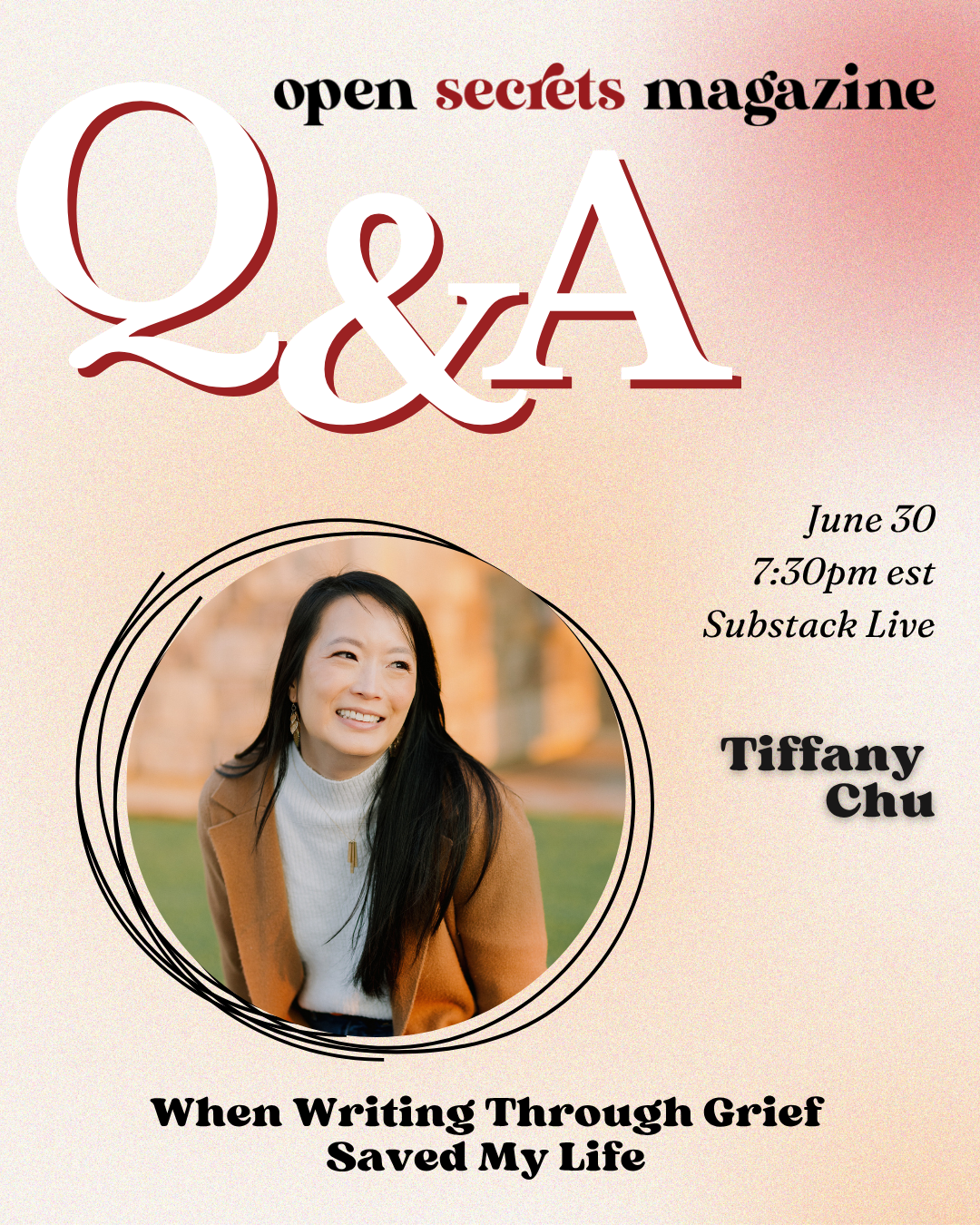
Many thanks to Rachel from Open Secrets Magazine for featuring this essay. I'll be chatting with Rachel about grief and writing on Substack Live 😱 on June 30.

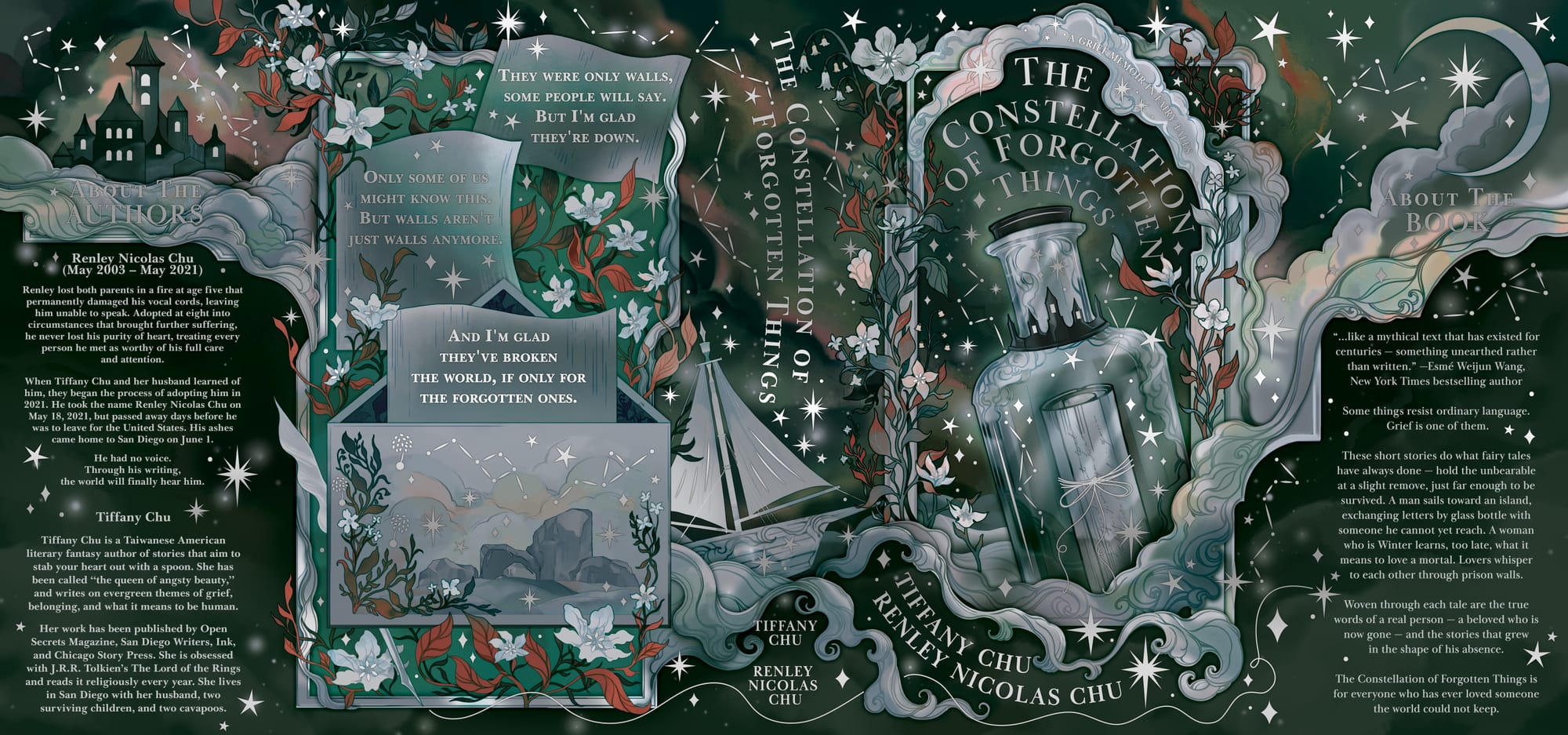
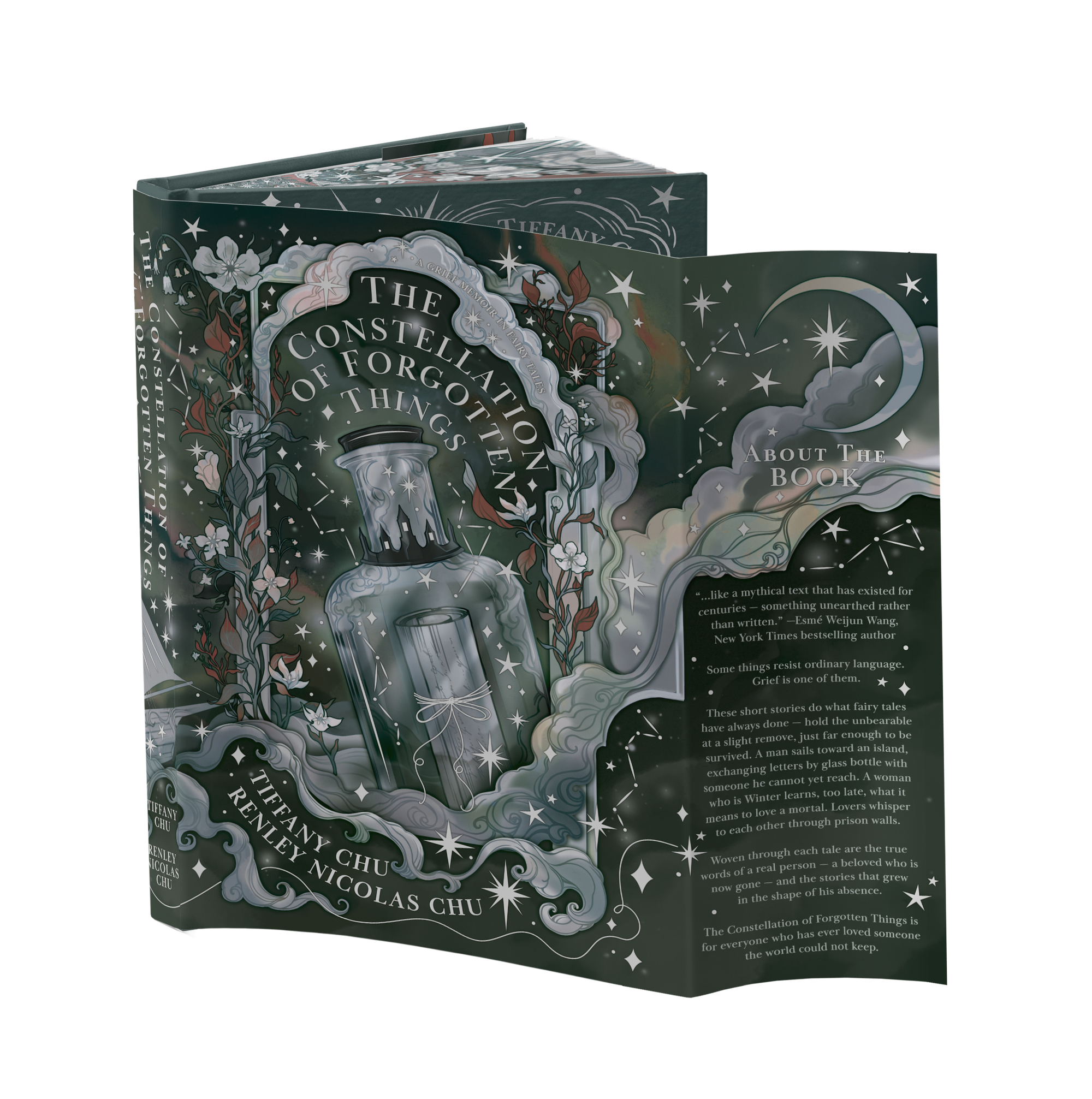
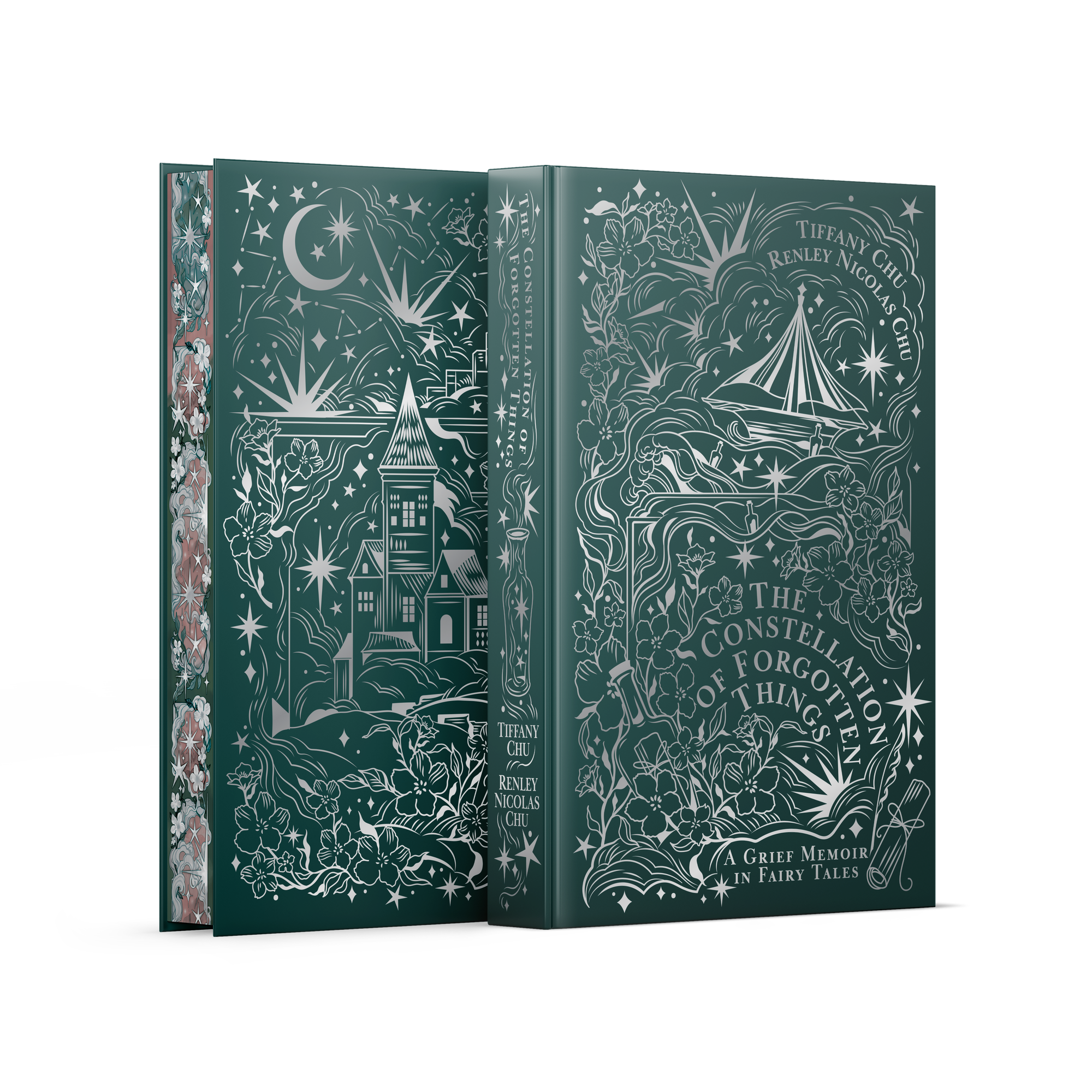
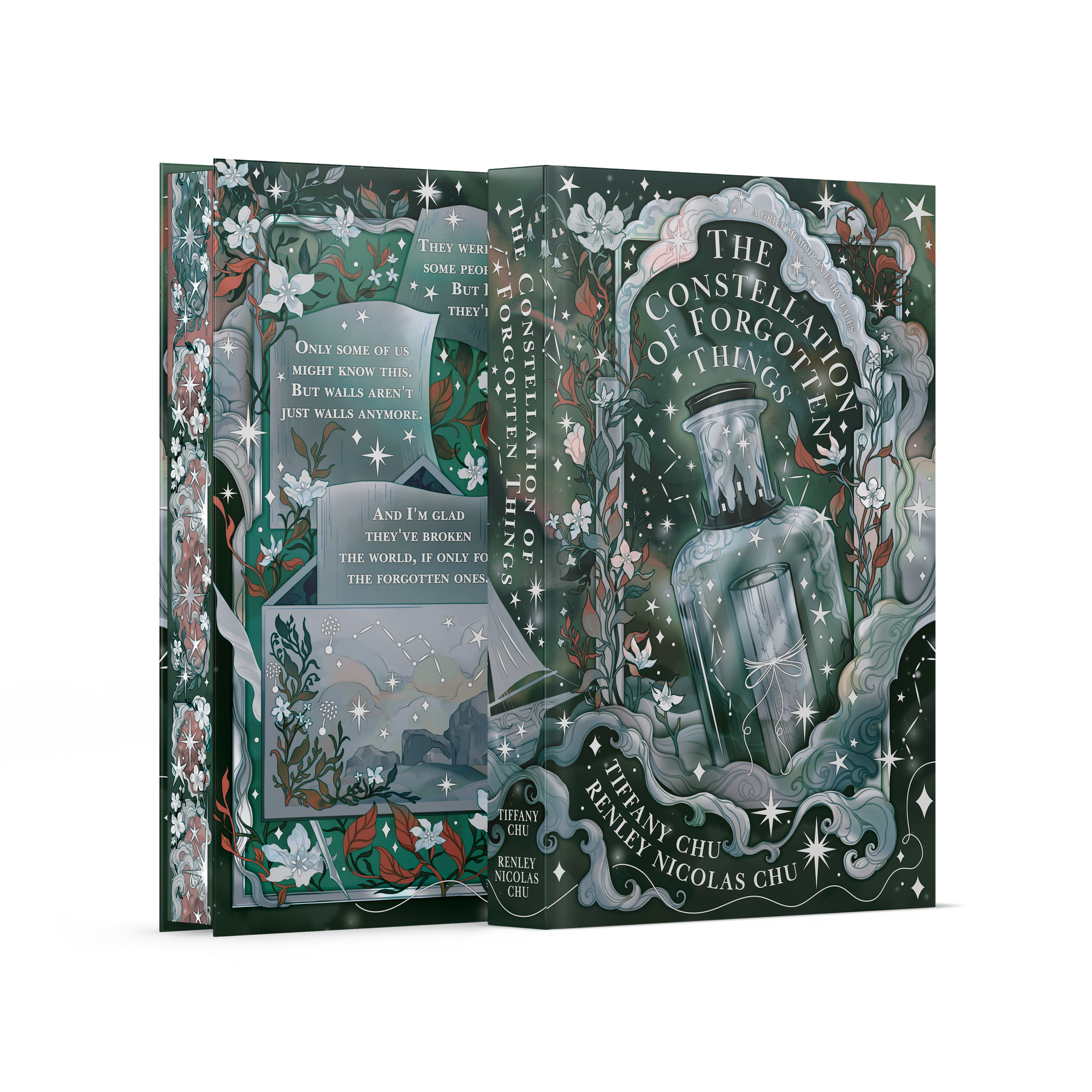
The cover for The Constellation of Forgotten Things is complete!! Look at this amazingness by Angela Chen (duckhymn).
There's a Goodreads giveaway going on for the A Girl Made of Time digital version, if you haven't grabbed that yet! Congratulations to Madi Lou for winning the previous A Girl Made of Time giveaway!
While making money is absolutely not my motivation for writing, I do have a goal of making this my long-term career. I've been happy with Ghost's ability to wall off posts to only subscribers, which has largely diminished the need to paywall most of my more intimate writing. That will continue for the foreseeable future, because I value you, my Inkling, but I don't necessarily want to open up my writing to any passer-by, willy nilly. I also appreciate the freedom Ghost provides (not being tied to a platform, etc.).
However, I want this to be a sustainable practice. For that, I do need your help. Ghost itself costs $552 a year, and I would really like to stay here so I can keep these personal essays free for all subscribers, and retain my freedom. If just 12 of you upgrade to at least the Kindred tier ($50/year), we can keep going here for another year. Or, if 1/3 of you upgraded at the lowest tier ($15/year, less than $2/month), we'd be more than set for a good long while. 🩵
This September will mark three years since putting down the foundations for this beautiful fellowship. There's so much more I'd love to do with this space. If my writing has moved you, made you think in a different way, or been something you look forward to reading, I'd love to have you join our intimate circle of Inklings.
As always, all patrons are welcome to join my casual Signal messenger group, where we chat about books and pets, even sports on rare occasions (albeit on accident lol). It's where I'm most active and usually share live updates on any book news.
- The Girl and the Goblin Prince is complete! Read the whole thing here. It's undergone developmental editing with the ever-excellent S.E. Reid, so I'm now in the process of revising it for publication.
- My new essay collection, The Untangling: Volume 2, is out in ebook, print, AND audiobook (narrated by me) today! This book consists of essays published right here in 2025, many of these previously only available to paid subscribers, and focuses on certainty, uncertainty, faith, and friendship. The ebook is free for patrons, as always.
- Events I'll be at are listed on this page. The next one coming up is San Diego's A Year in Ink: Volume 19 Celebration on June 29, where I'll be doing a reading of my essay, "Tracing Your Shadow Through Shifting Leaves," along with other authors being published in the anthology.
- I've been curating book lists this year for those who like recommendations. It'll be an ongoing project, so there aren't many yet, but I'll continue adding as I read. While I don't send out my book reviews as emails unless I entwine it as an essay, they'll always be linked on this page.
- A timeline of updates on all my projects can be found here.
- Little snippets of life and stuff I would have posted to social media are found here.
- As an indie author, I don't have a publishing team behind me to help market my books, so I rely heavily on word of mouth and reviews to reach new readers. If you've read one or more of my books, please take a moment to leave a review here and/or here. Even a brief "I loved it!" or "I hated it!" would be great! It truly makes a huge difference. Thank you so much!
Whew, that was a lot. Thanks for bearing with me!
With Love,


The short story collection I wrote with Ren is launching on September 15, 2026. We wrote it for those who grieve. Sign up here to be notified when it launches.
About Me: Tiffany Chu is a Taiwanese American writer based in San Diego. Her essays and short stories have been published by Open Secrets Magazine, San Diego Writers Ink, and Chicago Story Press. She writes about evergreen themes of grief, belonging, and what it means to be human. She's been writing this publication, The Untangling, since 2023. Order my books here.
Submit your questions:
No spam, no sharing to third party. Only you and me.


Member discussion